

.png)
Summary
- Traditional 90-day QBRs are too slow; AI shifts sales coaching to a daily feedback loop, boosting performance in real-time.
- AI-driven insights deliver measurable results, including a 50% reduction in new hire ramp time and revenue increases of up to 15%.
- Automate administrative tasks like note-taking and call summaries to allow sales reps to focus fully on conversations and building relationships.
- Leverage AI sales coaching platforms like Hyperbound to provide personalized, scalable feedback that helps your team close more deals.
You've just wrapped up another marathon sales call and you're sitting there trying to remember what was discussed. Your notes are a jumbled mess because you were either fully engaged in the conversation or frantically typing like a maniac—there was no in-between. Sound familiar?
"Sometimes I legit don't remember what we even agreed on by the end of the call, especially if it went off-script," confesses one sales rep on Reddit. Another laments, "My calls feel like improv and then I'm scrambling to remember what actually mattered."
This daily struggle is compounded by an even bigger problem: the painfully slow feedback cycle that has dominated sales organizations for decades. While you're drowning in a sea of conversations, trying to capture insights and improve your technique, your organization is likely still relying on the antiquated Quarterly Business Review (QBR) to evaluate your performance.
But what if there was a way to transform this slow, backward-looking process into a system of daily growth and improvement? What if AI could not only solve your note-taking nightmare but also provide immediate, personalized feedback that helps you close more deals faster?
The Old Guard: Why the Quarterly Business Review Is No Longer Enough
The traditional sales Quarterly Business Review (QBR) is a formal meeting where reps and managers review past performance and plan for the next quarter. It's a structured process that typically follows four key steps:
- Examine Important KPIs: Teams analyze metrics like total sales, time to conversion, and churn rates.
- Reflect on Team Performance: Managers and reps discuss successes and challenges, trying to uncover insights not immediately apparent in the data.
- Leverage Data to Drive Decisions: Past performance is used to adjust future targets and strategies.
- Look to the Future: The meeting concludes with an action plan for the next quarter.
While this approach has been a staple in sales organizations for years, it has significant limitations in today's fast-paced sales environment:
.png)
It's Backward-Looking: QBRs analyze what has already happened, making it difficult to correct course on deals currently in your pipeline. By the time you receive feedback on a mistake you made in January, it's already April—and you've likely repeated that same mistake dozens of times.
It's Infrequent: A 90-day feedback loop is glacially slow in today's dynamic market where buyer behaviors and competitive landscapes can change weekly.
It Lacks Granularity: QBRs fail to address the nuances of individual calls—those critical moments where you either connect with a prospect or lose them. They can't capture the reality of sales calls that "feel like improv" where you're "scrambling to remember what actually mattered."
The New Paradigm: Shifting to Real-Time, AI-Powered Feedback
Enter the era of continuous feedback powered by artificial intelligence. Instead of waiting three months for insights, sales professionals are now leveraging AI tools that provide immediate feedback after every call, creating a cycle of daily growth rather than quarterly reflection.
This shift is addressing the very pain points that sales reps express daily:
Automated Note-Taking and Summaries
Remember that frustration of being a "maniac typer" during calls? AI tools are eliminating this problem entirely.
"We use Teams Premium and love it for capturing full transcription, AI summary, and all follow ups," shares one sales professional on Reddit. Another mentions, "Cluely lately. It just kinda runs in the bg and spits out decent summaries after each call… like objections, action items, that kinda stuff."
Tools like Hyperbound, Fathom, Otter, and Teams Premium act as AI assistants, capturing complete transcriptions of your calls and automatically generating summaries with key action items, objections, and performance insights. This allows you to be fully present in conversations instead of splitting your attention between listening and documenting.
Real Call Scoring & Performance Analysis
Modern AI platforms are going beyond simple summarization to provide detailed performance analytics:
"I love chorus," mentions one rep, referring to the popular call analysis tool. Platforms like Hyperbound use AI to score actual sales calls, providing personalized feedback and reports on your performance.
This enables tracking of granular metrics on a daily basis, including:
- Activity Metrics: Talk time, follow-up rate, call-to-close ratio
- Conversion Metrics: Win rate, sales cycle length, deal slippage rate
According to Everstage, effective sales performance tracking transforms raw data into actionable insights that can be applied immediately—not three months later.
Personalized Coaching and Skill Development
Perhaps the most powerful aspect of AI-powered sales feedback is its ability to deliver personalized coaching at scale.
Gartner introduces the concept of "Atomic Insights"—AI-extracted, synthesized, easy-to-consume feedback from calls that allows sellers to get critical guidance without hours of manual review. This means each rep receives coaching tailored to their specific strengths and weaknesses, rather than generic feedback that applies to the entire team.
AI analyzes patterns across all your calls to identify skill gaps and trends, enabling targeted improvement in areas like handling objections, effective questioning, or value proposition delivery.
The Tangible Results: How AI Delivers Measurable Growth
The shift from quarterly reviews to daily AI-powered feedback isn't just a nice theoretical improvement—it's delivering measurable business results:
Faster Onboarding and Ramp Time
AI-driven training platforms can decrease ramp time by 50%, according to Hyperbound. This addresses a common pain point expressed by experienced sales professionals who find traditional training methods frustrating: "My boss is making us role play cold calls with AI bots LMAO. I've been making cold calls for a decade btw," laments one rep on Reddit.
But AI roleplays aren't just about learning basics—they're about perfecting skills at any level. Kevin Dorsey, CRO at Finally, notes that tools like Hyperbound allow reps to not just practice but perfect their techniques through consistent, objective feedback.
Increased Revenue and ROI
The financial impact of AI-powered sales coaching is substantial:
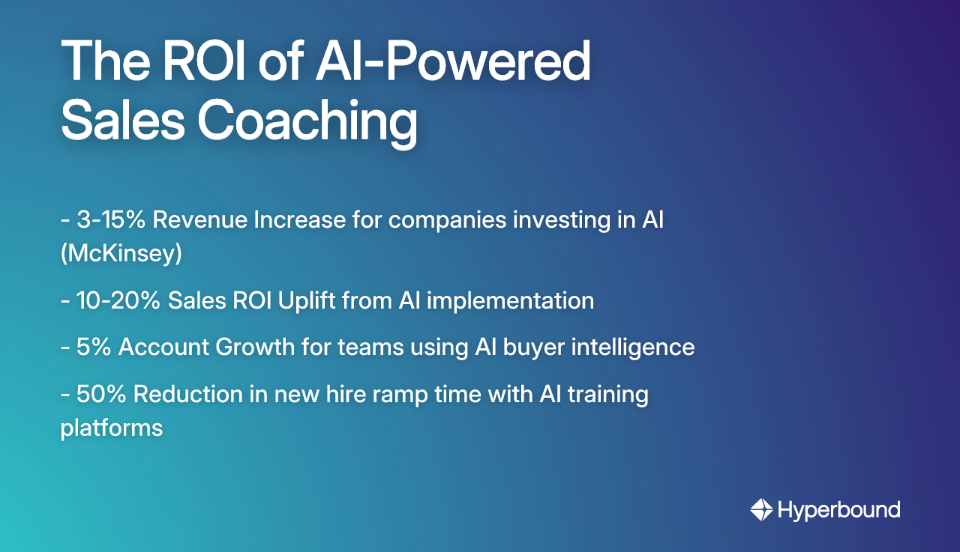
- McKinsey reports that companies investing in AI are seeing revenue increases of 3-15% and sales ROI uplifts of 10-20%.
- Gartner research shows that sales teams using buyer intelligence (powered by AI) can increase account growth by 5%.
These aren't marginal improvements—they're game-changing results that directly impact the bottom line.
Improved Forecasting Accuracy
Only 7% of sales teams achieve a forecast accuracy of 90% or more, according to Gartner. AI automates the data collection and analysis needed for more accurate forecasting, moving beyond gut feelings to data-driven predictions that help organizations better allocate resources and set realistic targets.
Enhanced Productivity
AI technology is predicted to automate 20% of current sales-team functions, according to McKinsey. This isn't about replacing reps—it's about freeing them from administrative tasks to focus on building relationships and closing deals.
Overcoming the Hurdles: Addressing Skepticism and Implementation Challenges
Despite the clear benefits, there are legitimate concerns about AI in sales that need addressing:
Fear of Job Replacement
"Are the AI making calls? It's becoming standard in my line of work. Which f*** up," worries one sales professional.
This fear is understandable but misplaced. AI is best viewed as a copilot, not a replacement. Gartner introduces the concept of "Agentic AI," which can manage tasks like prospecting but is designed to augment, not replace, the seller. The goal is to automate low-value tasks to free up humans for high-value strategic conversations that AI simply cannot replicate.
Frustration with Inaccurate Tools
"I've tried tools that claim to track tone but end up highlighting the wrong things like your tone dipped here… yeah bro I was sipping water," shares another rep.
Not all AI is created equal. It's important to choose proven tools and leverage peer recommendations. Tools like Hyperbound, Chorus, read.ai, and Otter receive positive mentions from actual sales professionals who use them daily.
The Need for a Cultural Shift
Implementing AI is more than a technical challenge—it requires a significant change in sales culture. Gartner highlights that transitioning to AI-augmented processes requires teams to trust and integrate AI as a supportive tool. Managers must be trained to use AI insights for constructive coaching, not as a micromanagement tool.
The Future of Sales Performance: Daily Growth, Not Quarterly Reviews
The era of waiting 90 days for performance feedback is over. The future of elite sales performance lies in leveraging AI for a continuous cycle of action, feedback, and growth.
AI transforms sales feedback from a quarterly chore into a daily advantage, leading to faster skill development, increased productivity, and significant revenue growth. The most successful sales organizations will be those that effectively partner human talent with AI intelligence, using technology to empower their people to do what they do best: build relationships and sell.
By embracing this shift from quarterly reviews to daily AI-powered feedback, your sales team can stay present in conversations, capture critical insights automatically, and receive the personalized coaching they need to close more deals—starting today, not next quarter.
Frequently Asked Questions
Why are Quarterly Business Reviews (QBRs) no longer sufficient for modern sales teams?
Quarterly Business Reviews (QBRs) are no longer sufficient because their 90-day feedback loop is too slow, backward-looking, and lacks the detailed insights needed for today's fast-paced sales environment. This traditional approach means feedback on performance often arrives too late to impact current deals. QBRs provide a high-level overview but miss the granular, call-by-call nuances where deals are won or lost.
How does AI transform the sales feedback process?
AI transforms the sales feedback process by shifting it from an infrequent, quarterly review to a continuous, daily cycle of improvement. It provides immediate, automated, and personalized coaching after every sales call. Instead of waiting three months for a manager's review, sales reps can use AI tools to get instant analysis of their conversations, including transcriptions, summaries, objection tracking, and performance scores.
What are the primary benefits of using AI in sales coaching?
The primary benefits of using AI in sales coaching include faster onboarding for new hires, increased revenue and ROI, improved sales forecasting accuracy, and enhanced team productivity. Real-world results show that AI can reduce new hire ramp time by up to 50%, increase company revenue by 3-15%, and automate administrative tasks to free up reps' time for selling.
Will AI replace the jobs of sales professionals?
No, AI is not designed to replace sales professionals but rather to augment their abilities and act as a "copilot." The goal of AI in sales is to automate repetitive, low-value tasks like note-taking and data entry. This frees up sales reps to focus on high-value activities that require human intelligence, such as building relationships, strategic thinking, and closing complex deals.
What kind of AI tools can help with sales call analysis?
Several AI tools are available for sales call analysis, including platforms like Hyperbound, Fathom, Otter, Chorus, and Microsoft Teams Premium. Some tools excel at transcription and summarization, while others like Hyperbound and Chorus provide deeper performance analytics, real call scoring, and personalized coaching insights to help reps identify specific areas for improvement.
How does AI-powered feedback help experienced sales reps?
AI-powered feedback helps experienced sales reps by providing objective, data-driven insights to help them perfect their techniques and identify subtle patterns or habits they may not be aware of. Even seasoned professionals can benefit from targeted coaching, as AI can analyze thousands of calls to uncover nuanced trends in their performance, providing a consistent, unbiased way to refine advanced skills.
Book a demo with Hyperbound


