.png)


.png)
Summary
- The average B2B sales cycle has increased by 25% to four months, but AI sales enablement tools can reduce it by up to 40%.
- Shortening your sales cycle is one of the most effective ways to increase revenue, as halving the cycle time can double your monthly revenue velocity without needing more deals or reps.
- Key strategies include using AI for lead scoring to focus on qualified buyers, automating personalized follow-ups, and preparing reps for tough conversations.
- AI sales coaching platforms like Hyperbound provide a safe environment for reps to practice handling objections and master playbooks, which directly addresses common deal-stalling bottlenecks.
You've set up your sales process, trained your team, and equipped them with the latest CRM. Yet your sales cycle keeps dragging on, stretching from weeks into months. Deals that should close quickly get stuck in endless loops of follow-ups, stakeholder approvals, and technical validations.
Meanwhile, your revenue targets aren't getting any smaller.
If this sounds painfully familiar, you're not alone. The average B2B sales cycle has increased by a staggering 25% over the past five years and now stretches to approximately 4 months. Nearly 43% of sales leaders report lengthening cycles that eat into their revenue goals and team productivity.
But what if you could cut that sales cycle nearly in half? What if your team could close the same deals in 60 days instead of 120?
This isn't wishful thinking. Organizations integrating AI sales enablement tools are reporting up to a 40% reduction in their sales cycle duration. This isn't about working harder—it's about equipping your SDRs (Sales Development Representatives) and AEs (Account Executives) with intelligent tools that eliminate the bottlenecks slowing down your deals.
Why Your Sales Cycle Is Dragging (And How to Quantify the Damage)
Before diving into solutions, let's identify exactly where your sales cycle is leaking time. These common bottlenecks add weeks (sometimes months) to your cycle:
.png)
(Source)
"But just how much is this costing us?" you might ask. Here's the Revenue Velocity Formula to quantify the impact:
Revenue = Opportunities × Deal Size × Win Rate ÷ Sales Cycle Length
Let's put this into perspective with a simple example:
- 50 opportunities per month
- $25,000 average deal size
- 30% win rate
- 120-day sales cycle
Monthly revenue velocity = 50 × $25,000 × 0.3 ÷ 4 = $93,750
Now, watch what happens when you cut your sales cycle in half to 60 days: Monthly revenue velocity = 50 × $25,000 × 0.3 ÷ 2 = $187,500
That's a 100% increase in monthly revenue without changing your team size, deal count, or win rate. This illustrates why shortening your sales cycle might be the most powerful lever for increasing revenue.
Decoding AI Sales Enablement: More Than Just Automation
AI sales enablement isn't just about automating email sequences or scheduling follow-ups. It's about fundamentally improving how you prepare and equip your sales team by reducing manual tasks and delivering data-driven insights at critical moments.
Consider this: sales reps currently spend only 28% of their time actually selling. The rest gets consumed by administrative tasks, searching for information, and creating materials. AI helps reclaim that lost time and focuses reps on high-value activities.
The core technologies driving this revolution include:
- Generative AI: Creates new content (emails, proposals, call summaries) based on data patterns, saving reps hours of manual work weekly
- Predictive Analytics: Identifies which leads have the highest likelihood of converting based on behavioral patterns
- Real-Time Intelligence: Delivers contextual information during live sales calls—exactly when reps need it most
This directly addresses the pain many sales teams express on platforms like Reddit: "What happens when a rep is mid-call and needs to remember how to handle that pricing objection?" With AI enablement, that information appears right when they need it.
How AI Crushes Bottlenecks to Achieve a 40% Faster Cycle
Let's break down exactly how AI tackles each major bottleneck in your sales process:
1. AI-Powered Lead Scoring (Fixes Poor Qualification)
When your team pursues unqualified leads, they're essentially chasing ghosts. AI lead scoring analyzes thousands of data points to identify which prospects match your ideal customer profile and show buying intent.
Tools like Highperformr AI and People.ai automatically analyze prospect behavior, engagement, and firmographics to create accurate lead scores that help your team focus on ready-to-buy opportunities.
This targeted approach alone can reduce your sales cycle by 2-4 weeks and slash the number of unqualified leads by up to 50% when combined with frameworks like BANT or MEDDIC.
2. Automated & Personalized Outreach (Fixes Inadequate Follow-Up)
Studies show that 80% of sales require 5+ follow-ups, yet 44% of salespeople give up after just one attempt. AI solves this through:
- Intelligent email sequences that adapt based on prospect engagement
- Personalized messaging that references specific pain points
- Optimal timing recommendations for follow-up communications
Tools like Regie.ai can generate personalized outreach content while Lavender provides real-time email coaching to improve response rates. This automation alone saves 1-2 weeks per deal by eliminating gaps in communication.
3. AI-Powered Sales Coaching (Fixes Objection Handling & Ineffective Demos)
"Sales representatives struggle with remembering crucial information during calls," notes one sales leader on Reddit. The best way to fix this is to give them a safe place to practice before they face a real customer.
AI sales coaching platforms like Hyperbound create hyper-realistic roleplays where reps can practice handling objections, delivering demos, and navigating tough conversations against an AI buyer. This allows them to build muscle memory and master your playbook without risking live deals. These platforms can then score real customer conversations to provide objective feedback, highlighting exactly where reps are excelling and where they need to improve.
While other tools like Gong or Dialpad can provide real-time assistance during live calls, proactive practice ensures reps are prepared for any scenario. This approach enables reps to combine discovery and demo calls with confidence, reducing delays by 7-10 days and creating a smoother buying experience.
4. Intelligent Content Management (Fixes Disorganized Information)
One of the most common complaints from sales teams is "scattered information across platforms." AI-powered Content Management Systems (CMS) like Seismic and Showpad solve this by:
- Automatically surfacing the most relevant content for each deal stage
- Recommending case studies and testimonials that match the prospect's industry
- Personalizing proposals based on previous interactions
According to Seismic's State of AI in Enablement Report, this intelligent content delivery helps reps build trust and close deals 15-20% faster.
The Data Doesn't Lie: The ROI of AI in Sales
The business case for AI in sales enablement is compelling:
- 50% of organizations already use AI in sales enablement, and 82% of them plan to increase their investment
- Teams using AI report a 63% higher revenue impact compared to non-users
- 92% report enhanced sales forecasting accuracy with AI
- 88% of organizations using AI report improved customer satisfaction
Your 4-Week Action Plan to a Shorter Sales Cycle
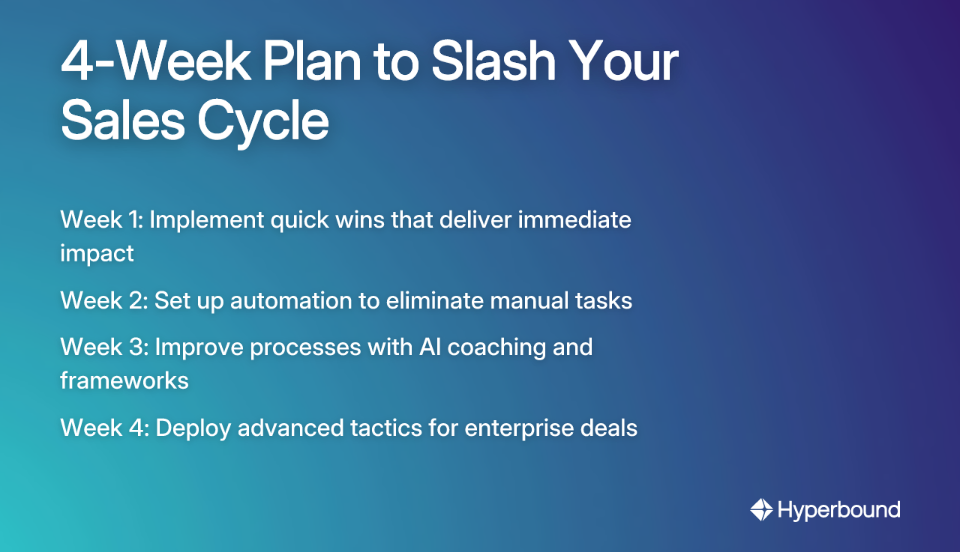
Ready to put AI to work in your sales process? Here's a practical roadmap:
Week 1: Quick Wins
- Discuss pricing on the first call to cut cycle time by 1-3 weeks
- Implement an AI tool like Lavender for email coaching
- Use personalized video messages to increase engagement
Week 2: Set Up Automation
- Implement automated email follow-up sequences
- Set up an AI-powered lead scoring model in your CRM
- Begin recording and analyzing calls with a tool like Hyperbound, Gong, or Dialpad for analysis
Week 3: Improve Processes
- Standardize qualification frameworks like MEDDIC/BANT
- Combine discovery and demo calls into a single meeting
- Deploy an AI sales coaching platform like Hyperbound to let reps practice objection handling and master their talk tracks
Week 4: Advanced Tactics
- Standardize contracts to save 2-8 weeks on enterprise deals
- Develop a structured Proof-of-Concept (POC) process
- Implement multi-threading strategies to engage multiple stakeholders
The Human Side of AI: Navigating Challenges and Fostering Adoption
While the benefits are clear, implementing AI in sales comes with challenges:
Data Privacy & Integration: Ensure your AI tools comply with regulations and integrate seamlessly with your existing CRM. Start with a small, high-impact use case before scaling.
Fear of Micromanagement: As one sales professional on Reddit noted, some AI coaching platforms can feel like micromanagement and "bring a concerning vibe to work." Frame these tools as AI coaching assistants that provide reps with feedback to improve, not as surveillance. Foster open dialogue about their use.
Lack of Team Buy-in: Involve your reps in crafting new processes to ensure adoption and avoid the mistake of "confusing activity with progress."
Stop Chasing Deals, Start Accelerating Them
AI sales enablement isn't replacing your sales team—it's supercharging them by automating repetitive work, providing real-time intelligence, and hyper-personalizing customer experiences.
By attacking the specific bottlenecks that prolong your sales cycle, AI can help you achieve that 40% reduction in cycle time, directly impacting your revenue velocity and bottom line.
The path forward is clear: identify your single biggest sales cycle bottleneck and explore one AI tool that can solve it. Use the 4-week plan as your guide, and you'll be closing deals faster than you ever thought possible.
Your competitors are already embracing this technology—can you afford to be left behind?
Frequently Asked Questions
What is AI sales enablement?
AI sales enablement involves using artificial intelligence tools to equip your sales team with data-driven insights, content, and coaching to improve their performance and efficiency. It goes beyond simple automation by using technologies like generative AI to create personalized content, predictive analytics to score leads, and real-time intelligence to assist reps during calls. The goal is to reduce manual tasks and allow salespeople to focus more on high-value activities like selling.
How does AI help shorten the sales cycle?
AI shortens the sales cycle by directly targeting and resolving common bottlenecks such as poor lead qualification, inadequate follow-up, and ineffective objection handling. For example, AI-powered lead scoring ensures your team focuses only on high-intent prospects. Automated, personalized outreach prevents deals from stalling due to communication gaps. AI coaching platforms prepare reps for tough conversations, allowing them to handle objections confidently and close deals faster, potentially reducing the cycle by up to 40%.
What are the main sales cycle bottlenecks AI can fix?
The main sales cycle bottlenecks that AI can fix include poor lead qualification, inadequate follow-up, disorganized content, ineffective objection handling, and delays in technical validation. AI tools address these by scoring leads to prioritize the best opportunities, automating personalized communication, surfacing relevant content at the right time, and providing realistic coaching scenarios for reps to practice handling difficult customer questions.
Will AI replace my sales team?
No, AI is not designed to replace your sales team but rather to augment their capabilities. The goal of AI sales enablement is to supercharge your reps by automating repetitive administrative tasks, which currently consume a significant portion of their time. This frees them up to focus on what humans do best: building relationships, understanding nuanced customer needs, and closing complex deals. AI acts as a co-pilot, not a replacement.
How can I ensure my sales team adopts new AI tools?
To ensure adoption, involve your sales team in the selection and implementation process, frame the tools as assistants for improvement rather than surveillance, and start with a small, high-impact use case. Gaining team buy-in is crucial. Communicate the benefits clearly—how the tool will help them close more deals and reduce tedious work—and provide thorough training to ensure they are comfortable and confident using the new technology.
What is the typical ROI of using AI in sales?
The return on investment (ROI) from AI in sales is significant, with teams reporting up to a 40% reduction in sales cycle length, which can double monthly revenue velocity. Beyond faster cycles, organizations using AI also report a 63% higher revenue impact compared to non-users, improved forecasting accuracy, and enhanced customer satisfaction. By automating tasks and providing data-driven insights, AI helps teams close more deals with the same or fewer resources.
Book a demo with Hyperbound


