

.png)
Summary
- SaaS SDRs operate in a world of extreme call volume (sometimes 1,300 calls per meeting booked), requiring specialized scoring tools not built for AE deal cycles.
- Most scoring tools excel at analysis but fail to close the "insight-to-action gap," leaving reps with data but no integrated way to practice and improve.
- Effective SDR scoring must cover 100% of calls, focus on SDR-specific metrics like opener effectiveness, and directly link performance gaps to coaching actions.
- Hyperbound's "score-and-practice" loop connects AI Real Call Scoring with targeted AI Sales Roleplays to help reps improve continuously and book more demos.
If you've ever Googled "best AI sales call scoring software," you've probably landed on a list built for a generic, full-cycle sales team — one that talks a lot about deal forecasting, AE pipeline health, and revenue intelligence dashboards.
That's not what you need.
SaaS outbound SDR teams operate in a completely different world. One Reddit thread put it bluntly: "the average SDR at my org books a meeting every 1300 cold calls." That's not a typo. These reps are grinding through absurd call volumes, expected to hit quotas like 7 booked meetings a month, often with "maybe one qualified inbound every two months." And they're trying to reach decision-makers — often in IT — who "almost never pick up the phone or respond to emails."
In this environment, the scoring criteria that matter are hyper-specific:
- Cold call openers: Does the rep nail the first 15 seconds before the prospect hangs up?
- Multi-threading discovery: Is the rep uncovering the right stakeholders, or talking to someone with no authority?
- SaaS-specific objections: Is the rep confidently handling "we already use [competitor]" or "budget is frozen until Q3" — not with a generic script, but with a compelling, tailored response?
So before we get to the list, here's the evaluation frame we used — because a great SDR scoring tool must support:
- Methodology adherence — Is the rep following the proven playbook (MEDDIC, BANT, SPICED)?
- Value proposition clarity — Is the value communicated concisely and compellingly within a 2-minute cold call?
- Next-step commitment rate — How effectively is the rep securing a concrete next step, like a booked demo?
- Volume coverage — Can the tool score every call, not just the ones a manager cherry-picks?
- Insight-to-action loop — Does the tool actually help reps improve, or does it just generate dashboards?
With that frame set, here are the 7 best AI call scoring tools for SaaS and outbound SDR teams.
.png)
1. Hyperbound (Perform + Practice)
Best for: SaaS and outbound SDR teams who want to move beyond analysis and actually change call performance
Most sales call scoring software stops at the analysis. Hyperbound doesn't.
Hyperbound is the Revenue Activation Platform — a category it coined to describe what happens when teams stop just analyzing call data and start using it to change outcomes. For SDR teams specifically, it's the only platform that closes the full loop: score real calls → identify skill gaps → practice to fix them → score again.
Here's how the SDR workflow plays out in practice:
Hyperbound Perform — AI Real Call Scoring Perform automatically scores 100% of your team's real customer conversations against custom methodology scorecards. It integrates with Gong, Salesloft, Chorus, and other call recording systems — so you don't have to rip and replace your existing stack. Every cold call gets scored against the criteria that actually matter for SDRs: opener effectiveness, objection handling, value prop delivery, and whether the rep secured a next step.
Auto-CRM FillOne of the biggest hidden time drains for SDRs is manual CRM data entry after every call. Hyperbound Perform's Auto-CRM Fill automatically updates CRM fields from call transcripts — saving reps hours per week and keeping your pipeline data clean without sacrificing selling time.
Hyperbound Practice — AI Sales Roleplays This is where Hyperbound separates itself from every other tool on this list. Once Perform identifies a gap — say, a rep is consistently fumbling the "we already use a competitor" objection — that rep gets targeted Bitesized Roleplays to practice that exact scenario. The AI buyer personas are trained on 2M+ hours of real B2B sales conversations, not generic blog posts. (If you've ever complained that AI tools are "trained on mediocre blogposts" and fail to replicate real buyer behavior, this directly addresses that gap.)
Kota Activate — AI Revenue Analyst Kota sits above Practice and Perform, orchestrating coaching interventions. It recommends specific roleplays for reps based on their real call performance and surfaces deal risk signals for managers — turning raw performance data into guided actions.
The proof: Diamond marketplace Nivoda used Hyperbound's score-and-practice loop and saw a 150% increase in demo booking rate and a 50% reduction in SDR ramp time. Vanta cut ramp from 210 to 72 days (a 60% reduction) and grew their BDR team 4x. LinkedIn has 3,000+ sellers across multiple business units using the platform.
The operational loop — Hire → Onboard → Score → Identify Gaps → Practice → repeat — is what makes Hyperbound the only end-to-end solution on this list.
2. Gong.io
Best for: Enterprise sales organizations needing comprehensive revenue analytics
Gong is the market leader in conversation intelligence and a staple recommendation whenever SDRs ask how to analyze cold calls with AI. It captures interactions across phone, email, and video conferencing, and surfaces deal intelligence, competitive mentions, and rep behavior trends at scale.
For managers overseeing large SDR teams, Gong's call libraries and coaching workflows are genuinely powerful — you can find the best cold call in your library, clip it, and share it across the team in minutes.
Where it falls short for SDRs: Gong is an analytics and intelligence tool. It excels at showing you what happened but lacks a native practice environment to help reps fix what went wrong. The insight-to-action loop requires a manager to manually assign follow-up coaching — a bottleneck in high-volume SDR environments. If your scoring criteria is deeply SDR-specific (opener quality, methodology adherence, next-step commitment rate), you'll need to configure custom scorecards carefully to get relevant output.
3. Chorus.ai (by ZoomInfo)
Best for: Teams already in the ZoomInfo ecosystem
Chorus.ai uses "Moment Identification" technology to automatically surface key parts of a call — objections raised, competitors mentioned, pricing discussions — and scores conversations against defined criteria. Its deep integration with ZoomInfo's B2B data adds a layer of market intelligence that AEs managing larger deals tend to value highly.
For SDRs, the automated scoring and trend tracking features are genuinely useful. If your team is running structured cold call blocks and needs to quickly identify patterns across hundreds of calls — which openers are landing, which objections are coming up most — Chorus gives you that visibility.
Where it falls short for SDRs: Like Gong, Chorus is primarily an analysis layer. There's no integrated practice environment where reps can take a flagged coaching moment and immediately roleplay it with an AI buyer persona. The workflow from "your opener is weak" to "here, practice a better one right now" requires stepping outside the platform entirely.
4. Nooks AI
Best for: SDR teams looking for dedicated AI roleplay practice alongside scoring
Nooks AI combines AI roleplay bots with real-time scoring to create a more rep-centric coaching experience. Reps can practice cold call conversations with AI buyer personas that simulate realistic pushback, and get scored on metrics like talk-to-listen ratios and key selling behaviors.
For SDR managers who want to coach through a practice-first approach rather than pure call analysis, Nooks offers a more hands-on environment than traditional conversation intelligence tools.
Where it falls short for SDRs: Nooks offers both practice and scoring, but the connection between analyzing real call performance data and then generating customized practice scenarios based on those specific findings is where Hyperbound's integrated Perform → Practice → Activate model differentiates. The depth of the AI buyer personas — and the methodology by which skill gaps from real calls directly inform what reps practice next — is a meaningful distinction for teams looking to systematically close performance gaps.
5. Salesloft
Best for: Sales teams wanting an all-in-one engagement and scoring platform
Salesloft is a sales engagement platform at heart — it handles email cadences, dialing, sequencing, and pipeline management. Conversation intelligence and call scoring are included, but they're one feature among many rather than the core competency.
For SDR teams already using Salesloft for outreach sequencing, having basic call scoring within the same platform reduces tool sprawl and keeps reps' workflows consolidated. The platform also integrates natively with Hyperbound Perform, so teams who want deeper scoring without switching tools can layer both.
Where it falls short for SDRs: Call scoring in Salesloft lacks the analytical depth and SDR-specific customization of purpose-built sales call scoring software. Coaching capabilities are more limited, and there's no AI roleplay environment for targeted skill development. It's a solid engagement platform that includes scoring, not a scoring platform built for SDR coaching.
6. Balto
Best for: High-volume call centers focused on real-time script adherence and compliance
Balto takes a different approach from the tools above: instead of post-call analysis, it provides live guidance during the call. As a rep is speaking, Balto surfaces dynamic checklists, objection-handling prompts, and compliance notifications in real time — keeping reps on script and on message.
For certain outbound environments — particularly regulated industries where script compliance is mandatory — Balto's real-time layer is genuinely valuable.
Where it falls short for SDRs: Balto helps reps survive the current call; it doesn't build the long-term skill base needed to master complex SaaS sales conversations. The score-and-practice methodology that compounds SDR improvement over months doesn't really apply here. If a rep doesn't understand why a particular objection response works, having it prompted in real time doesn't close that developmental gap.
7. Allego (formerly Refract)
Best for: Organizations already invested in the Allego sales enablement platform
Refract, now absorbed into Allego's broader sales readiness platform, offers call analysis and coachable moment identification within a larger content and enablement ecosystem. If your org is already using Allego for sales content management, certification pathways, and learning, the conversation intelligence layer integrates into that existing infrastructure.
Where it falls short for SDRs: As part of a large suite, the call scoring capabilities may not have the dedicated depth or SDR-specific workflow design of a purpose-built tool. Critically, the automated loop between real call performance data and targeted AI practice is less tightly defined — meaning the insight-to-action journey still relies heavily on manager intervention rather than systematic, platform-driven coaching.
Frequently Asked Questions
What is AI sales call scoring software?
AI sales call scoring software automatically listens to, transcribes, and analyzes sales conversations to evaluate performance against predefined criteria. It uses natural language processing (NLP) to identify key moments, such as methodology adherence (e.g., MEDDIC), competitor mentions, objection handling, and value proposition delivery. This gives sales leaders objective, data-driven insights into rep performance across 100% of calls, eliminating the need for manual review.
Why do SaaS SDR teams need specialized AI call scoring tools?
SaaS SDR teams need specialized tools because their sales environment is fundamentally different from that of full-cycle Account Executives. Generic scoring tools are often built for long, complex deal cycles. SDRs, however, operate in a world of high-volume, short-duration cold calls where success is determined in the first 30 seconds. A specialized tool focuses on SDR-specific metrics like opener effectiveness, multi-threading discovery, and securing the next step, rather than pipeline health or deal forecasting.
What are the most important features of an AI call scoring tool for SDRs?
The most important features for an SDR-focused tool are those that support high-volume coaching and rapid skill development. Key features include:
- Methodology Adherence: Scoring calls against your specific playbook (e.g., BANT, SPICED).
- Volume Coverage: The ability to analyze 100% of calls automatically, not just a small sample.
- SDR-Specific Metrics: Tracking opener success, value prop clarity, and next-step commitment rates.
- Insight-to-Action Loop: A system that doesn't just provide data but actively helps reps improve, for instance by connecting skill gaps to a practice environment.
How does AI call scoring actually improve SDR performance?
AI call scoring improves SDR performance by providing a fast, continuous feedback loop that connects insights to action. Instead of waiting for a weekly 1:1, reps get immediate, objective feedback on their calls. Leading platforms identify specific weaknesses (like fumbling a certain objection) and can automatically assign targeted practice exercises or roleplays. This systematic approach accelerates learning, reduces ramp time, and directly leads to better outcomes like increased demo booking rates.
What is the difference between call scoring and AI sales practice platforms?
Call scoring platforms analyze past performance, while AI sales practice platforms build future skills. A call scoring tool like Gong or Chorus excels at telling you what happened on real customer calls. A practice platform provides a safe environment with AI buyer personas for reps to roleplay and master their talk tracks. The most effective solutions, like Hyperbound, integrate both, creating a complete loop: they score real calls to identify gaps and then use that data to drive targeted AI practice to fix them.
How does Hyperbound differ from tools like Gong or Chorus for SDRs?
Hyperbound differs by creating a complete "score-and-practice" loop designed specifically for SDRs, whereas tools like Gong and Chorus are primarily focused on analysis and revenue intelligence. While Gong and Chorus are powerful for understanding what happened on a call, they leave the "how to fix it" part to managers. Hyperbound connects the dots automatically: its Perform module scores real calls to find skill gaps, and its Practice module provides targeted AI roleplays to close those gaps, creating a system for continuous rep improvement.
Stop Analyzing. Start Activating.
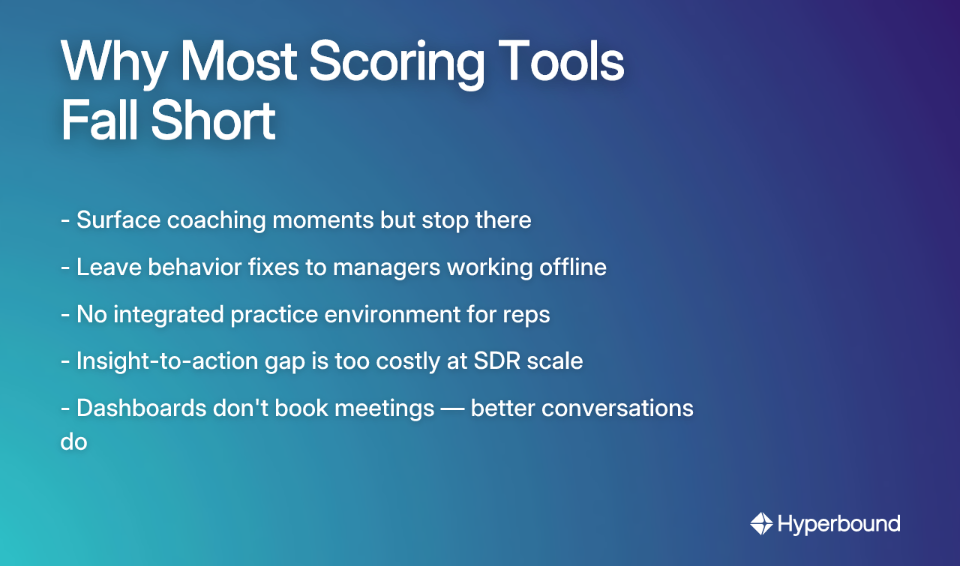
The best AI call scoring software for SDR teams isn't the one with the most dashboards — it's the one that closes the gap between insight and action.
Raw data doesn't book meetings. Better conversations do.
Every tool on this list can tell you something useful about your team's calls. But most stop there. They surface a coaching moment, generate a report, and leave the hard work of actually fixing the behavior to managers and reps working offline. In a high-volume SDR environment where reps are making hundreds of calls a week and burning out under unrealistic quotas, that gap is too expensive to ignore.
Hyperbound is the only platform on this list that completes the full loop. Perform scores 100% of your team's real calls and pinpoints exactly where reps are losing conversations. Practice turns those gaps into targeted AI roleplays — built from 2M+ hours of real B2B sales data — so reps can fix their cold call opener, objection response, or next-step ask before the next call block starts. And Kota orchestrates the whole system, recommending the right coaching intervention at the right time.
That's not just call scoring. That's Revenue Activation.
The results speak for themselves: Nivoda's SDR team achieved a 150% increase in demo booking rate and cut ramp time by 50% using exactly this loop. Vanta reduced ramp from 210 to 72 days. LinkedIn scaled it across 3,000+ sellers.
If your SDR team is grinding through calls without a system that turns scoring insights into actual skill development, it's time to change that.
See how Hyperbound scores and coaches your SDR team →
Book a demo with Hyperbound


