.png)


.png)
Summary
- AI prospecting boosts pipeline performance by 10-25% by shifting focus from high-volume, low-success outreach to data-driven precision.
- AI tools analyze your sales data to build a dynamic Ideal Customer Profile (ICP) and identify critical buying signals like new executive hires or tech stack changes.
- The most effective strategy combines AI's efficiency with human oversight, using AI to automate research and draft outreach while reps add authenticity and final judgment.
- Once AI identifies your perfect prospect, ensure your team is ready for the high-stakes first conversation by practicing with tools like Hyperbound's AI Sales Roleplays.
You've heard it before: "People wanna buy from people." It's the rallying cry of sales professionals who worry that AI might strip away the human touch that closes deals. And they're right about one thing—sales is fundamentally human.
But here's the paradox: most sales reps spend less than 30% of their time actually selling. The rest? Lost to manual research, endless cold calling, and administrative tasks that drain energy and kill momentum.
What if AI wasn't about replacing human connection, but amplifying it? What if instead of sending 100 generic messages hoping for 3 responses, you could send 20 perfectly tailored messages to prospects who are already showing buying signals—and get 15 responses?
This is the promise of AI prospecting: not robotic sales, but superhuman sales intelligence. Industry research shows that teams using AI for prospecting see a remarkable 10-25% lift in pipeline performance and revenue increases of up to 1.3x compared to non-users.
In this article, we'll explore how forward-thinking sales teams are using AI to find their perfect customers—and more importantly, arrive prepared to win those crucial first conversations.
The New Prospecting Playbook: From Guesswork to Data-Driven Precision
Traditional prospecting relies heavily on static Ideal Customer Profiles (ICPs) created through educated guesswork and limited data. This approach leads to a "spray and pray" strategy—high volume, low success rate—that frustrates both sales teams and prospects.
AI prospecting flips this model on its head.
Defining Your ICP with Machine Learning
Instead of building your ICP on assumptions, AI analyzes your historical sales data—wins, losses, deal cycles, and customer behaviors—to create a dynamic, data-backed profile of your perfect customer.
This machine learning approach reveals patterns no human would catch:
- Which combinations of company attributes correlate with shorter sales cycles
- Hidden connections between buyer titles and conversion rates
- Industry-specific language that indicates buying intent
- Technical indicators that predict implementation success
By leveraging these insights, sales teams can focus their energy on prospects with the highest probability of converting, rather than casting a wide net and hoping for the best.
Uncovering Hidden Markets and Buying Signals
Beyond refining your existing ICP, AI excels at identifying entirely new market opportunities through predictive analytics.
Imagine discovering that companies who've recently switched CRMs are 3x more likely to buy your sales enablement tool, or that businesses posting specific job descriptions signal they're about to invest in solutions like yours. These are the kinds of actionable insights AI prospecting tools can uncover by analyzing vast datasets of company information, social media, job boards, and public financial data.
Critical buying signals AI can detect include:
.png)
- New executive hires in relevant roles
- Technology stack changes
- Funding announcements
- Expansion into new markets
- Shifts in digital strategy
- Changes in online behavior or content focus
By identifying these signals early, sales teams gain a significant competitive advantage—approaching prospects at precisely the moment they're most receptive to solutions.

The AI Toolkit: How to Automate Research and Personalize Outreach
Now that you understand how AI redefines who to target, let's explore the practical tools that transform how you target them.
Automating Prospect Research
The research phase of prospecting has traditionally been a major time sink. Sales reps spend hours digging through LinkedIn profiles, company websites, and news articles for relevant information on potential clients.
AI agents now act as virtual research assistants, gathering and synthesizing information from multiple sources in minutes. For example, one leading tech company achieved a 60% reduction in prospect research time after implementing AI research tools. This efficiency allowed their sales team to have more actual conversations—the part of selling that humans do best.
These tools typically:
- Pull relevant information from social profiles and company databases
- Summarize recent news and announcements
- Identify mutual connections and relationship opportunities
- Flag relevant trigger events (leadership changes, funding, etc.)
- Compile competitive intelligence and industry context
Hyper-Personalization at Scale
A common concern with AI tools is that they produce generic messages that savvy prospects can spot instantly. As one sales professional on Reddit noted, "I can easily ID a salesly LI message or email IMMEDIATELY."
The solution isn't to abandon AI but to leverage it more effectively. Advanced Natural Language Processing (NLP) allows AI to draft highly relevant, personalized outreach that references specific details from a prospect's background, recent company news, or shared connections.
This isn't just a nice-to-have—it's what customers expect. According to research from Accenture, 91% of consumers prefer brands that provide relevant recommendations and offerings. Using AI for hyper-personalization allows you to meet this expectation at scale.
The Human-in-the-Loop Imperative
That said, the most successful sales teams view AI as an assistant, not an autopilot. As one sales operations professional wisely observed, "When it is wrong, it is only through my knowledge and experience that I am able to recognize it is wrong and fix the problem."
The human-in-the-loop approach means:
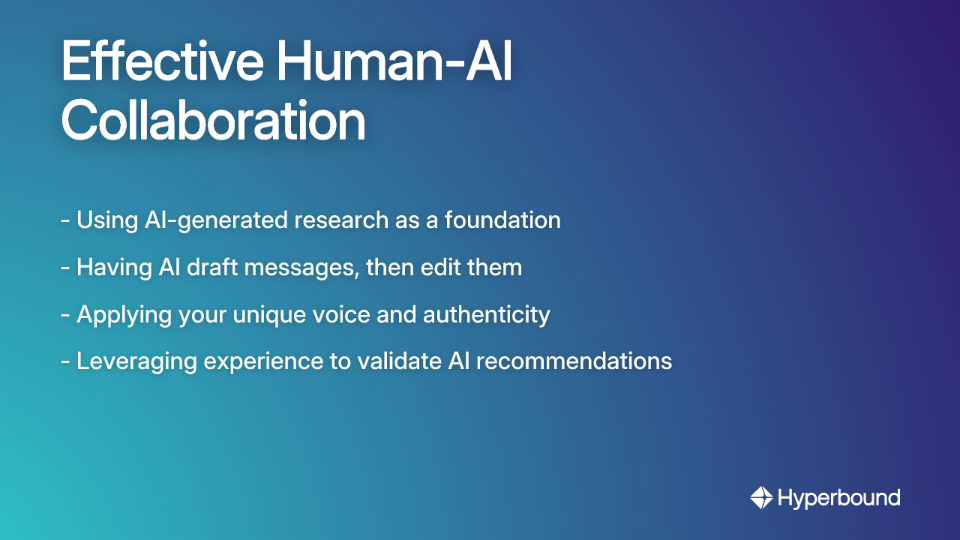
- Using AI-generated research as a foundation
- Having AI draft personalized messages, but reviewing and editing them
- Applying your unique voice and authenticity to communications
- Leveraging your industry experience to validate AI recommendations
This collaborative approach combines AI's efficiency with human judgment, ensuring outreach remains authentic while dramatically increasing productivity.
You've Found Your Perfect Customer. Are You Ready for the Conversation?
Finding the perfect prospect creates a high-stakes situation. That first conversation is your moment of truth—and cold calling remains challenging "due to people's reluctance to engage," as many sales professionals acknowledge.
When you've used sophisticated AI to identify a high-value prospect, you can't afford to fumble the opportunity with an unprepared pitch or clumsy handling of objections. This is where preparation becomes critical.
According to the latest State of Sales report, improving training was cited as the #1 growth tactic for sales leaders. Top performers don't wing it—they practice until perfect.
This is where tools like Hyperbound's AI Sales Roleplays provide a crucial advantage. By simulating realistic sales conversations with AI buyer personas that mirror your identified ICP, sales reps can practice their cold calls, discovery questions, and objection handling in a risk-free environment.
These practice sessions allow reps to:
- Test different opening approaches for specific personas
- Practice handling common objections before they arise
- Master the discovery questions that uncover real pain points
- Receive immediate feedback on their delivery and messaging
- Build confidence through repetition without risking real deals
The data shows that reps who regularly practice through AI roleplays demonstrate greater confidence, more consistent messaging, and higher success rates when engaging with actual prospects.
A Step-by-Step Guide to Implementing AI Prospecting
Ready to transform your sales approach with AI prospecting? Here's a practical framework to get started:
Step 1: Define Success Metrics & Audit Your Data
Before implementing any AI tool, clearly define what success looks like:
- Are you aiming to increase qualified leads by 20%?
- Do you want to reduce research time per prospect by 50%?
- Is your goal to improve conversion rates from initial calls?
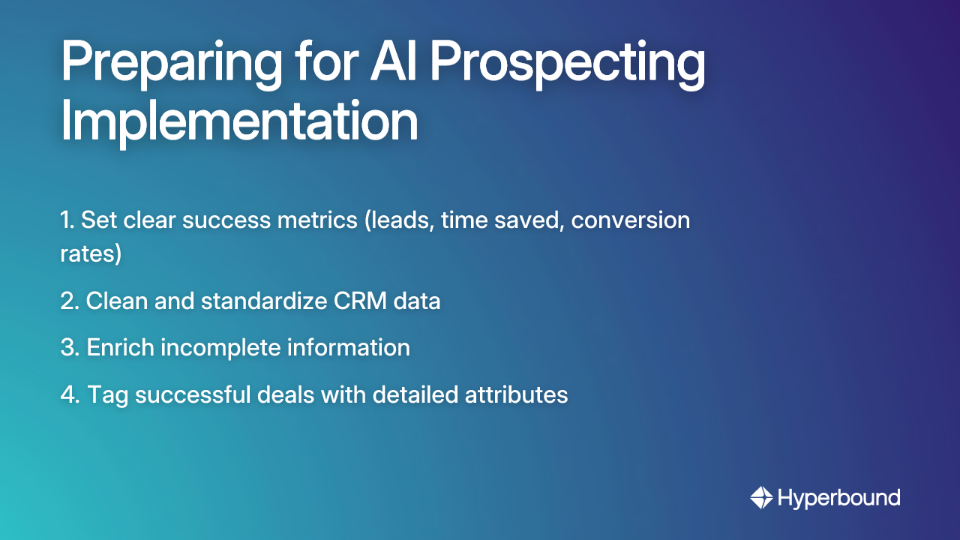
Then, audit your CRM data. AI is only as good as the data it's fed. Take time to:
- Clean up duplicate records
- Standardize field formats
- Enrich incomplete information
- Tag successful deals with detailed attributes
This foundation work pays dividends in AI accuracy and effectiveness.
Step 2: Start with a Pilot Program
Rather than a company-wide rollout, begin with a focused pilot program:
- Select a small, diverse team of sales reps
- Choose specific AI tools for one or two use cases
- Set clear metrics to evaluate effectiveness
- Run the pilot for 60-90 days
- Gather quantitative results and qualitative feedback
This approach allows you to measure ROI and refine your implementation strategy before scaling.
Step 3: Integrate Your Tech Stack and Train Your Team
Ensure your AI prospecting tools integrate seamlessly with your existing CRM and sales engagement platforms. This creates a unified workflow that makes adoption easier.
When training your team, address the "discomfort with AI interactions" by emphasizing how AI helps them, not replaces them:
- Show how AI eliminates tedious tasks
- Demonstrate the time saved on research
- Highlight how personalization increases response rates
- Explain the "human-in-the-loop" approach
Position AI as their competitive advantage, not their replacement.
Step 4: Analyze, Coach, and Optimize
The process doesn't end once your team starts using AI for prospecting. Continuous improvement requires:
- Regular analysis of outreach performance
- Identifying which messages and approaches work best
- Coaching reps on effective AI collaboration
Tools like Hyperbound's AI Real Call Scoring can automatically analyze actual sales conversations, providing objective, data-driven feedback on what's working and what isn't. This allows managers to scale coaching efforts and ensure the entire team adopts winning behaviors when engaging with high-value prospects.
The platform's AI can identify patterns across thousands of calls, pinpointing exactly which talk tracks, questions, and responses consistently lead to successful outcomes with different buyer personas—creating a continuous feedback loop for optimization.
Your New Partner in Sales: The Human + AI Advantage
Throughout this article, we've examined how AI is reshaping the prospecting landscape—not by replacing human sellers, but by empowering them with unprecedented intelligence and efficiency.
The future of sales isn't about choosing between AI or human connection. It's about leveraging AI to eliminate inefficiencies so that salespeople can focus on what they do best: building relationships and solving problems.
Smart sales teams understand this partnership approach:
- AI handles data analysis and pattern recognition at scale
- AI automates repetitive research and administrative tasks
- AI provides practice environments for skill development
- Humans bring empathy, judgment, and authentic connection
- Humans provide the expertise to validate and refine AI outputs
- Humans deliver the trusted advisor relationship buyers seek
As one sales professional aptly put it, "People wanna buy from people. I don't think that'll ever change." And they're right. But the salespeople who will win in this new era are those who embrace AI as their strategic partner—finding perfect customers with precision and arriving prepared to win their business.
The question isn't whether AI will transform sales prospecting. It already is. The question is: will you be at the forefront of this transformation, or playing catch-up to competitors who got there first?
Book a demo with Hyperbound


