.png)


.png)
Summary
- Many experienced developers feel unprepared for technical interviews because they test performance and communication skills, not just the practical coding abilities used in daily work.
- Traditional preparation methods like grinding LeetCode are insufficient as they lack the real-time feedback on communication and structured thinking that is critical for success under pressure.
- To improve, developers should shift from passive study to active practice by simulating realistic interviews, verbalizing their thought process, and receiving objective feedback.
- AI-powered practice platforms like Hyperbound's AI Roleplay Hiring Assessments offer a safe environment to build these skills with realistic simulations and instant, data-driven coaching.
You've spent years writing code, building projects, and solving real-world problems. Yet somehow, the moment someone mentions "technical interview," your confidence crumbles like poorly structured JSON.
"It's pretty wild that as a developer you can code everyday and still not be prepared for interviews," laments one developer on Reddit, capturing the frustration felt by many. From the infamous whiteboard exercises to the seemingly endless stream of LeetCode problems, the disconnect between daily work and interview performance leaves many developers calling the process "cancerous."
The truth is, knowing how to code and knowing how to perform in a technical interview are two very different skills. While one requires practical problem-solving abilities, the other often feels like an artificial test of memorized algorithms and data structures under immense pressure.
But what if you could debug your interview performance the same way you debug your code?
Enter AI-powered interview practice tools—a new approach that's transforming how developers prepare for technical assessments by providing the interactive feedback loop that traditional preparation methods lack.
Why Traditional Interview Prep Falls Short
The standard advice for technical interview preparation hasn't changed much in years: study Data Structures & Algorithms (DSA), memorize solutions to common problems, and grind through practice questions.
Resources like the Tech Interview Handbook are undeniably valuable. Created with input from engineers at Google and Amazon, it provides a structured curriculum that has helped over 1,000,000 engineers land jobs at top companies. The handbook's curated lists like the Blind 75 (and its successor, Grind 75) help focus your efforts on high-impact questions.
But there's a fundamental problem: reading a handbook and grinding problems in isolation is like reading a textbook on swimming without ever getting in the water.
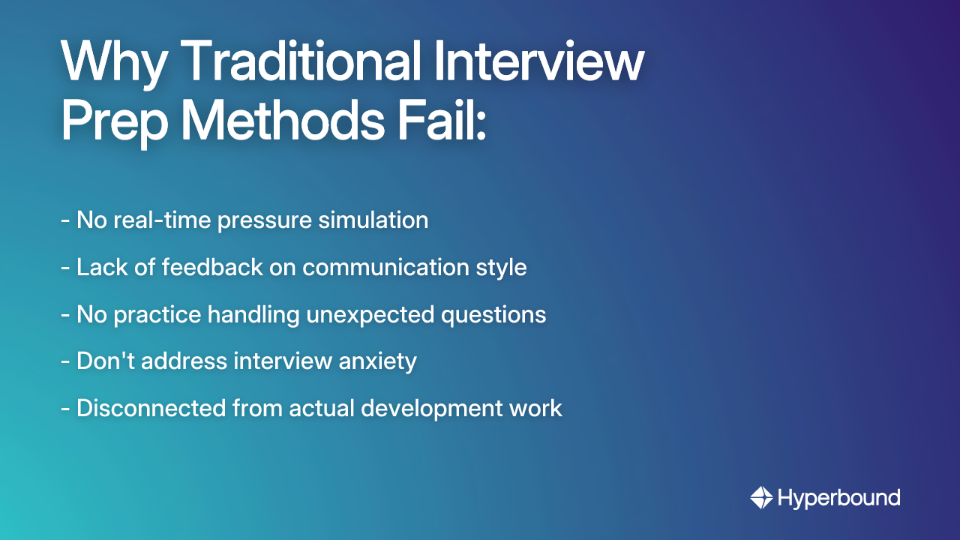
Static resources provide the "what" to study but not the "how" to perform. They don't:
- Simulate the pressure of explaining your thought process to a live interviewer
- Provide feedback on your communication style and clarity
- Help you practice handling unexpected follow-up questions
- Address the anxiety that causes many qualified candidates to underperform
As one frustrated developer puts it: "If it is not enough with my experience, projects, portfolio, github... and picking one of my projects and discuss it, I am not interested in the role." This sentiment reflects a growing disillusionment with a process that seems disconnected from the actual work developers do.
AI as Your Personal Interview Debugger
AI-powered interview platforms bridge this gap by functioning as an active, personalized training partner that helps you identify and fix the "bugs" in your interview performance.
AI-powered platforms like Hyperbound are pioneering this space by offering hyper-realistic practice scenarios that transform how developers prepare. These tools provide a safe, repeatable environment to hone both technical and communication skills, which are crucial for success. While other tools like StandOut also offer practice interviews, platforms that focus on dynamic, AI-driven feedback based on top performers are setting a new standard for effective preparation.
These platforms aren't replacing traditional study resources—they're enhancing them by adding the interactive, feedback-driven element that has been missing.
A Practical Guide: 5 Ways to Use AI to Ace Your Interview (Ethically)
.png)
Let's be clear: the goal isn't to cheat the system but to build genuine skills and confidence. Here are five ethical ways to use AI tools to improve your technical interview performance:
1. Simulate Hyper-Realistic Interview Scenarios
Generic question banks won't prepare you for the specific challenges of your target role. AI can generate questions tailored to specific companies, positions, and even experience levels.
How to implement: Use a platform like Hyperbound to generate hyper-realistic AI roleplays tailored to specific companies and roles. Instead of relying on static question banks, you can practice with an AI interviewer that mimics the scenarios you'd actually face at Google, Amazon, or Microsoft. This allows you to focus on front-end development, back-end architecture, or whatever aligns with your career goals in a dynamic environment.
This targeted approach addresses the common concern: "How much DSA questions do front-end positions really get asked?" By practicing role-specific questions, you'll be prepared for what actually matters.
2. Get Instant, Actionable Feedback
This is where the real "debugging" happens. After completing a mock interview, AI tools analyze multiple dimensions of your performance:
How to implement: Use an AI Coaching platform to receive instant, objective feedback on:
- Communication Clarity: Analyze the clarity of your explanations, your pacing, and use of filler words—all crucial elements, especially for non-native English speakers who often express anxiety about interviews.
- Structured Thinking: Get feedback on how well you defined the problem, articulated your approach, considered edge cases, and walked through your solution step-by-step.
Unlike a friend who might hesitate to be critical, AI provides unbiased, data-driven feedback that helps you identify patterns of weakness.
3. Clarify Complex Concepts on Demand
When you're stuck on a concept during your preparation, AI can function as an on-demand Socratic tutor.
How to implement: Struggling with the trade-offs between a hash map and a binary search tree for a specific problem? Instead of just searching for generic explanations, ask an AI tool to explain it in the context of your interview question. This transforms passive learning into active understanding.
This addresses the need for tools that make understanding fundamental concepts easier, as one developer mentioned: "I found that it helps you build a solid foundation before jumping into coding challenges."
4. Master the Art of the Mock Interview
Perhaps the biggest advantage of AI practice tools is the ability to reduce interview anxiety through repetition in a low-stakes environment.
How to implement: Schedule regular practice sessions where you verbalize your thought process out loud, just as you would in a real interview. The more you practice articulating your approach to problem-solving under simulated pressure, the more natural it will feel during the actual interview.
This accessibility means you can practice anytime, create custom interviews, and get instant feedback, transforming nervous energy into productive preparation.
5. Analyze Your Performance Against Proven Strategies
Top-tier platforms don't just give you feedback in a vacuum; they benchmark your performance against the proven strategies of top performers.
How to implement: With a tool like Hyperbound's AI Real Call Scoring, you can get your mock interviews automatically scored against a rubric built from the communication patterns of successful engineers. The AI can identify whether you're using the same techniques that help senior developers at leading companies articulate complex solutions effectively.
This moves beyond just "correctness" and helps you adopt the behaviors of those who consistently ace their interviews.
Stop Grinding, Start Debugging Your Performance
The traditional approach of passively grinding through LeetCode problems is no longer sufficient in today's competitive job market. By using AI to actively debug your interview performance, you address the real challenges of technical interviews: communication under pressure, structured problem-solving, and demonstrating your thought process clearly.
Instead of resenting the "superiority complex" of a broken system, you can walk in prepared and confident. Instead of worrying if DSA questions are relevant for your front-end role, you can practice questions specific to your domain and company targets.
The era of blindly memorizing algorithms without feedback is over. It's time to actively debug your entire interview approach. Try an AI interview practice platform today and start getting the personalized feedback you need to not just pass the technical interview, but to ace it.
Remember: even the most experienced developers continue to refine their skills. As one developer noted about their AI practice tool: "I built it, but I use it every day and I am a better engineer because of it."
Your next technical interview doesn't have to feel like debugging a production crisis with no error logs. With AI-powered practice, you can walk in with the confidence of knowing exactly where your strengths lie and how to compensate for any weaknesses—just like you would approach any other coding challenge.
Frequently Asked Questions
What are AI-powered interview practice tools?
AI-powered interview practice tools are platforms that simulate realistic technical interviews, providing a safe environment for developers to practice their coding and communication skills while receiving instant, data-driven feedback. Unlike static resources like LeetCode or handbooks, these tools function as an interactive training partner. They can generate questions tailored to specific companies and roles, analyze your explanations for clarity, and help you debug your performance by identifying weaknesses in your problem-solving approach and communication style.
Why are technical interviews so different from real developer work?
Technical interviews are different from daily coding work because they test a distinct set of skills, focusing on theoretical knowledge of data structures and algorithms under high pressure, rather than the practical, collaborative problem-solving skills used in a job. The article highlights that many experienced developers feel unprepared for interviews because the process often feels like an artificial test of memorization. Daily work involves using existing tools, collaborating with a team, and debugging complex systems over time. In contrast, an interview requires you to solve a novel problem from scratch and articulate your entire thought process live, which is a performance skill in itself.
How do AI tools improve communication skills for technical interviews?
AI tools improve communication skills by providing objective, specific feedback on how you explain your thought process during a mock interview. These platforms analyze aspects like the clarity of your explanation, your speaking pace, and the use of filler words. They can assess how well you structure your answer—from defining the problem to considering edge cases. This is a crucial advantage over self-practice, as it helps you refine the "how" you communicate, not just the "what" you code.
Can AI interview practice tools really reduce interview anxiety?
Yes, AI interview practice tools can significantly reduce interview anxiety by allowing you to practice repeatedly in a low-stakes, private environment. Interview anxiety often stems from the fear of the unknown and the pressure of being judged. By using an AI platform, you can familiarize yourself with the interview format, practice articulating your thoughts under simulated pressure, and build confidence through repetition. This process turns a high-stakes performance into a familiar routine, transforming nervous energy into preparedness.
Is using AI to practice for interviews considered cheating?
No, using AI to practice for interviews is not considered cheating; it is a legitimate and ethical way to build genuine skills and confidence. The goal of these tools is not to give you the answers to use during a real interview, but to help you improve your own performance. They act as a personal coach, providing a safe space to simulate interviews, get feedback, and refine your problem-solving and communication abilities. The article emphasizes using these platforms to prepare ethically, much like an athlete uses training equipment to prepare for a competition.
How do AI platforms provide better feedback than practicing with a friend?
AI platforms can provide better feedback than a friend because they are unbiased, data-driven, and can benchmark your performance against the proven strategies of thousands of top-performing engineers. While a friend can offer general advice, they may hesitate to be overly critical or may not know what interviewers at top companies are looking for. An AI tool provides objective, instant feedback on specific metrics like communication clarity and structured thinking. Advanced platforms can even score your performance against a rubric built from successful interviews, helping you adopt the behaviors of those who consistently succeed.
Book a demo with Hyperbound


