.png)


.png)
Summary
- Traditional buyer personas often fail because they are built on stereotypes and internal assumptions, not real customer data, making them static and impractical.
- AI solves this by analyzing your proprietary customer data—from CRM records to interview transcripts—to create dynamic, data-driven personas that reflect actual behaviors and needs.
- The most effective approach combines AI's data processing power with human validation to ensure personas are both accurate and actionable for marketing and sales strategies.
- To make personas truly actionable for sales teams, platforms like Hyperbound can transform them into interactive AI roleplays, allowing reps to practice with realistic customer profiles.
You've spent hours crafting detailed buyer personas. "Marketing Mary" with her corner office and work-life balance challenges. "Tech-Savvy Tom" who researches extensively before making decisions. They look impressive in your slide deck—but there's a problem.
They're not real. They're semi-fictional characters built on stereotypes and internal assumptions. And worst of all? They're collecting digital dust in a shared folder somewhere, rarely influencing your actual marketing decisions.
The Frustrating Reality of Traditional Personas
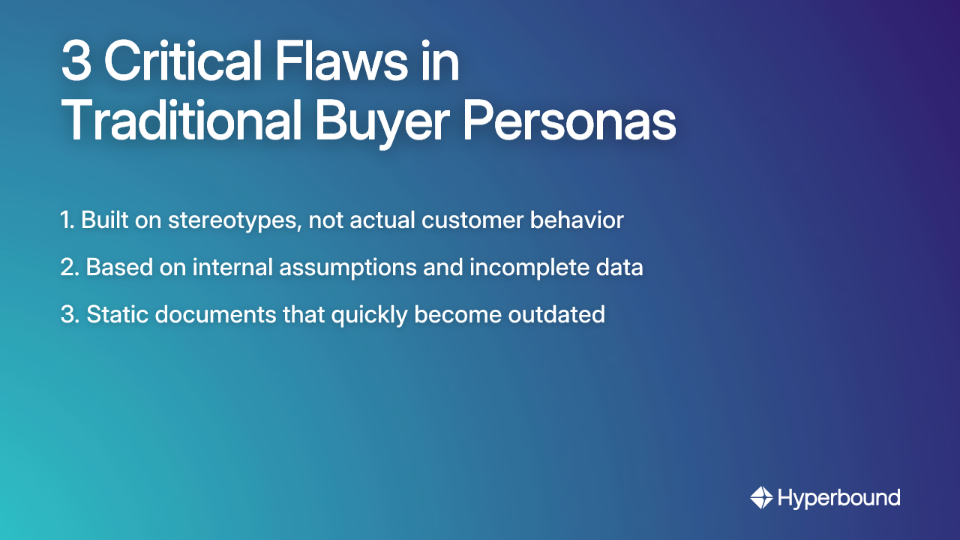
If you've ever struggled with creating or using buyer personas, you're not alone. The traditional approach to persona development is fundamentally flawed in three critical ways:
1. They're Built on Stereotypes, Not Reality
Many personas rely on job-title stereotypes that neglect individual behaviors, challenges, and objectives. They reduce complex human beings to simplistic caricatures like "HR Manager Helen" or "CEO Steve," focusing on demographic information rather than true motivations.
As one marketer noted on Reddit: "Marketing people care about marketing. IT people care about IT. And most professionals, regardless of position, care about being acknowledged for their contributions."
2. They're Based on Assumptions and Incomplete Data
For many businesses—especially new ones—creating personas becomes an exercise in guesswork. As one frustrated entrepreneur shared: "most of the information is for businesses that already have customers... I simply guess based on any information I have."
Even established companies often rely too heavily on internal perspectives (like sales team anecdotes) rather than systematic customer research, creating a distorted view of their audience.
3. They're Static Documents That Quickly Become Obsolete
Once created, personas typically become fixed documents rather than evolving guides. In rapidly changing markets with shifting customer preferences, static personas quickly lose relevance. They fail to capture the dynamic nature of real customer behavior.
Enter AI: The Realistic Practice Solution
Artificial intelligence offers a powerful solution to these longstanding challenges. AI-powered buyer personas are not simply digital versions of the same flawed approach—they fundamentally transform how we understand and use customer profiles.
But wait—isn't AI notorious for "making stuff up"? This legitimate concern was expressed by a skeptical marketer who worried: "AI is particularly good at making up stuff that may not actually exist in reality."
This gets to the heart of what I call the "realistic practice problem"—the gap between theoretical marketing tools and their actual usefulness in daily work.
This gap is especially critical in sales, where reps need to interact with personas, not just read about them. The solution is to make these personas interactive. Platforms like Hyperbound are pioneering this by using AI to analyze real customer conversations and build dynamic AI buyer personas that sales teams can practice with in realistic roleplays. This turns a static document into a live coaching tool.

The solution isn't about replacing human judgment with AI. It's about using AI to process vast amounts of real data to inform human judgment. Here's how AI solves the core problems:
Data Overcomes Assumptions
AI excels at processing diverse datasets—CRM records, purchase history, website analytics, social media engagement, customer feedback—to identify patterns that humans might miss. Instead of building personas on internal assumptions, AI builds them on actual customer behaviors and preferences.
Nuance Over Stereotypes
AI's pattern recognition capabilities can identify hidden customer segments and unexpected correlations. Rather than starting with a job title and working backward, AI can discover natural groupings based on behavioral patterns, content preferences, and purchase triggers—creating more nuanced and accurate representations.
Dynamic Over Static
Most importantly, AI enables personas to become living documents that evolve with new data. When customer behaviors shift, AI can detect these changes and update personas accordingly. This addresses the need for what one marketer described as "personas subject to change as more data comes in."
A Practical Guide to Creating Actionable AI Buyer Personas
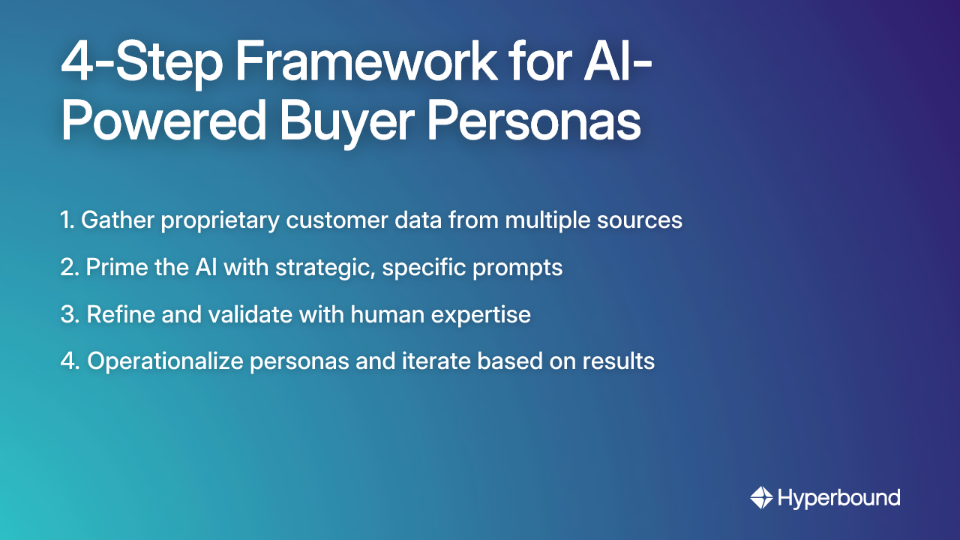
Let's move beyond theory to practice. Here's a step-by-step approach to leveraging AI for more realistic, useful personas:
Step 1: Gather Your Proprietary Data
This step directly addresses the common preference for personalized models: "If I built a model using my own data, I would likely get a better more accurate result than an AI."
The key is feeding the AI your unique data—not asking it to create personas from scratch. Gather:
- Qualitative data from customer interviews (Voice of Customer research)
- Professional data from LinkedIn profiles of ideal customers
- Behavioral data from your CRM, website analytics, and customer service interactions
- Market feedback from reviews, surveys, and social listening
Without this foundation of real-world data, your AI personas will indeed be fictional. With it, they become powerful reflections of reality.
Step 2: Prime the AI for Strategic Thinking
Don't just ask an AI tool to "create a persona." Instead, provide specific prompts that guide it toward useful insights.
Effective AI prompt examples:
"Based on the following interview transcripts and CRM data, create a buyer persona for our [product/service]. Focus on their primary goals, challenges, and the 'jobs to be done' they are trying to accomplish."
"Create a persona for our [product/service] targeted at [age group] in [location]. Detail their demographics, psychographics (interests, values, pain points), and preferred communication channels."
These structured prompts help the AI focus on information that will drive marketing decisions, not just compile random facts.
Step 3: Refine and Validate with Human Insight
The AI's output is a sophisticated first draft—not the final word. As one marketer wisely noted: "AI tools might give you a starting point, but no tool is going to know your specific audience better than you can."
Review the AI-generated content for accuracy and relevance. Enhance it with your team's domain expertise and qualitative understanding. Most importantly, validate key assumptions against real customer data.
Step 4: Operationalize and Iterate
A persona is only valuable if it's used. Integrate it into your workflow by:
- Defining key metrics that your persona should influence
- Using the persona in planning marketing strategies and content
- Tracking performance data against persona segments
- Regularly updating the persona based on new insights
This iterative approach ensures your personas remain relevant and actionable over time.
Avoiding the Pitfalls: A Skeptic's Guide to AI Personas
Let's address the most common concerns about AI-powered personas head-on:
Mistake 1: Overreliance on AI Without Factual Grounding
The Concern: "My main concern would be that AI is particularly good at making up stuff that may not actually exist in reality."
The Solution: Always ground the AI's work in your own data. The AI is a pattern-finder, not a novelist. Verify key assumptions against actual customer behavior before acting on them. Use AI to analyze real data, not to invent fictional customers.
Mistake 2: Using Limited or Generic Data Sources
The Concern: "When you build on the same data as your competitors, there will be little differentiation and you'll run into more roadblocks down the road."
The Solution: Incorporate diverse and proprietary data inputs—especially direct customer interviews and your unique analytics. This ensures your personas reflect your specific audience, not generic industry assumptions. The competitive advantage comes from your proprietary data, not the AI tool itself.
Mistake 3: Creating Personas and Forgetting to Validate Them
The Concern: "That doesn't mean that it is a good persona that is based in reality."
The Solution: Test AI-generated personas against actual marketing results. Do campaigns targeted at these personas perform better? Use A/B testing to confirm the persona's preferences and pain points in real-world scenarios. Let performance data guide refinements.
The Real-World Impact: A Case Study
Let's see how this works in practice with a real example from Clariant Creative.
They had a traditional persona named "Resource-Challenged Rita"—an experienced marketer with big goals but a small team and budget. The original persona was flat and lacked actionable depth.
By feeding AI qualitative data from client interviews and LinkedIn profiles, they discovered much deeper insights:
- Rita values collaboration and needs to prove measurable ROI to her superiors
- She actively seeks practical solutions, case studies, and templates that simplify her tasks
- She responds to relational and supportive marketing, not flashy promises
These AI-enhanced insights transformed their approach, leading them to create more templates and case studies—content that directly addressed Rita's actual needs, not just their assumptions about her.
Your Partner in Realistic Marketing
AI doesn't replace the marketer's strategic mind; it augments it. It solves the "realistic practice problem" by eliminating much of the guesswork, bias, and static nature of traditional buyer personas.
The most powerful approach is a partnership: human empathy and experience combined with AI's ability to process data at scale. This hybrid approach creates personas that are both realistic and practical—personas that actually influence your daily marketing decisions instead of gathering dust.
Stop guessing about your customers. Start by gathering your own data and experimenting with AI tools. Specialized platforms like Hyperbound can create dynamic personas from your actual sales calls for your team to practice with, while general tools like ChatGPT can help synthesize research. Transform your personas from forgotten documents into drivers of growth.
Remember: The goal isn't to create perfect personas. The goal is to better understand your customers so you can serve them more effectively. AI is simply a powerful tool to help you get there faster and with greater accuracy.
Are you ready to move beyond "Marketing Mary" and connect with your real customers?

Frequently Asked Questions
What is the main problem with traditional buyer personas?
The main problem with traditional buyer personas is that they are often semi-fictional, based on stereotypes and internal assumptions rather than real customer data. This leads to several critical flaws: they reduce complex individuals to simplistic caricatures, they are built on guesswork instead of actual behavior, and they exist as static documents that quickly become outdated. As a result, they are rarely used to make meaningful marketing or sales decisions.
How does AI improve buyer personas?
AI improves buyer personas by building them from actual customer data, identifying nuanced patterns humans might miss, and allowing them to be dynamically updated over time. Instead of relying on stereotypes, AI analyzes diverse datasets like CRM records and customer interviews to create data-driven profiles. Most importantly, AI personas can evolve as new data comes in, ensuring they remain relevant and accurate.
Can I create an AI buyer persona without existing customer data?
While it's possible to generate a hypothetical persona using AI without your own data, it is not recommended as it falls into the same trap as traditional personas—relying on guesswork. The true power of AI in persona creation comes from analyzing your unique, proprietary data. If you are a new business, your first step should be to gather initial market feedback and conduct interviews with potential customers to provide a real-world foundation for the AI.
How do I ensure my AI-generated persona is realistic and not just fiction?
The key to ensuring a realistic AI persona is to ground it firmly in your own proprietary customer data and validate the output with human expertise. The AI's role is not to invent a customer, but to find patterns within the real data you provide it. Always start with a foundation of customer interviews, CRM data, and analytics, then use your team's domain knowledge to review and refine the AI's output.
What is the most important step when creating AI buyer personas?
The single most important step is gathering high-quality, proprietary data from multiple sources. Without your own unique data, the AI will produce generic or fictional results. You should collect qualitative data (customer interviews), professional data (LinkedIn profiles), behavioral data (CRM, analytics), and market feedback (reviews, surveys). This data is the foundation that makes your AI-generated personas accurate and actionable.
How do AI buyer personas benefit sales teams specifically?
AI buyer personas benefit sales teams by transforming static documents into dynamic, interactive coaching tools. Platforms like Hyperbound can use data from real customer conversations to build AI personas that sales reps can engage with in roleplay scenarios. This allows them to practice handling objections and understanding customer pain points in a simulated, risk-free environment, turning a theoretical concept into a practical tool for improving sales performance.
Book a demo with Hyperbound


