.png)


.png)
Summary
- Businesses using conversation analytics are 8.5 times more likely to achieve over 20% revenue growth, according to Forrester.
- Traditional sales metrics are lagging indicators; AI conversation intelligence uncovers the winning behaviors in actual sales calls that drive performance.
- Advanced techniques like automated call scoring, objection analysis, and talk-ratio tracking provide actionable insights into what separates top performers from the rest.
- To turn these insights into results, use them to create targeted coaching and practice scenarios with tools like Hyperbound's AI Sales Roleplays, allowing reps to master winning behaviors at scale.
Are you drowning in sales data but starving for wisdom? You're not alone. Many sales leaders have access to endless metrics—sales data by product, by brand, by customer—yet still feel "lost with all this data at hand" and struggle to find "actionable insights, not just numbers."
Traditional sales metrics like call volume or deal close rates are merely lagging indicators. They tell you what happened, but not why. They don't reveal the quality of conversations that ultimately drive those outcomes.
This is where AI conversation intelligence changes the game. By analyzing the actual words, tone, and patterns in your sales conversations, AI can transform unstructured call data into structured, actionable insights that provide a clear roadmap for performance improvement.
The impact is undeniable: According to Forrester, businesses leveraging conversation analytics are 8.5 times more likely to achieve over 20% revenue growth.
Let's explore seven advanced techniques that go beyond surface-level metrics to uncover the winning behaviors hiding in your sales calls.
.png)
1. Automated Call Scoring Against Your Winning Playbook
What it is: Automated call scoring moves beyond subjective manager evaluations to a system where AI analyzes every single conversation and scores it against your predefined sales methodology or playbook.
Why it matters: This ensures 100% call coverage for quality assurance, eliminates human bias, and provides a consistent benchmark for performance across your entire team. Managers who are "overwhelmed by manual call reviews" can now focus on strategic coaching rather than tedious call analysis.
How AI enables it: AI uses Natural Language Processing (NLP) to identify whether a rep followed specific talk tracks, asked key discovery questions, mentioned competitor names appropriately, or established clear next steps—all without a human having to listen to hours of calls.
Hyperbound in Action: Hyperbound's AI Real Call Scoring automatically evaluates conversations against your custom methodology, tracking key behaviors and talk tracks. The platform also provides an AI Deal Summary to extract key moments, objections, and buying signals, saving managers countless hours of review time. This data feeds directly into Hyperbound's AI Coaching, which delivers instant, personalized feedback aligned with your company's methodology, allowing reps to self-correct immediately.
2. Granular Talk-to-Listen Ratio Analysis
What it is: This analysis examines the distribution of speaking time between sales reps and prospects. Advanced analysis goes beyond the overall ratio to examine speaking patterns during specific parts of the call (e.g., discovery vs. pricing discussions).
Why it matters: Top-performing reps are often exceptional listeners. A high rep talk-time during discovery often indicates they're pitching features instead of uncovering pain points. This metric helps coach reps to be more consultative and customer-centric.
How AI enables it: AI automatically transcribes calls and uses speaker diarization to precisely calculate talk time for each participant, flagging calls where the rep dominated the conversation when they should have been listening.
Hyperbound in Action: Hyperbound's AI-Powered Scorecards track talk ratios as a key performance metric in both real call analysis and roleplays. If a rep consistently shows poor talk-to-listen ratios, a manager can assign them specific AI Sales Roleplays focused on discovery to practice asking open-ended questions and active listening techniques in a safe environment.
3. Advanced Question Quality & Strategy Assessment
What it is: This technique moves beyond simply counting the number of questions to analyzing the quality and type of questions asked. Are they open-ended vs. closed-ended? Do they uncover business pain, impact, and desired outcomes?
Why it matters: The quality of a rep's questions directly correlates with their ability to control the sales process and build a strong business case. Poor questioning leads to weak discovery and deals that stall or fall apart later in the cycle.
How AI enables it: AI can categorize questions based on frameworks (e.g., BANT, MEDDIC) or by type (e.g., problem-focused, solution-focused, impact-focused). It flags calls where reps fail to ask critical qualifying questions that top performers consistently use.
Hyperbound in Action: When Hyperbound's AI analyzes calls, it identifies gaps in questioning strategy. For instance, if reps consistently fail to uncover budget information, a manager can create a "Budget Discovery" scenario in AI Sales Roleplays where the AI buyer persona is intentionally hesitant to discuss financials, allowing reps to practice this specific skill repeatedly until mastery.
4. Systematic Objection Handling & Response Analysis
What it is: This analysis identifies the most common objections that arise at different stages of your sales cycle and evaluates the effectiveness of your reps' responses.
Why it matters: This approach turns objection handling from an art into a science. By understanding top objections and codifying the best responses from top performers, you can create a playbook that lifts the performance of your entire team.
How AI enables it: AI automatically detects and clusters common objections (e.g., "it's too expensive," "we're happy with our current solution," "call me back next quarter"). It then correlates different response strategies with call outcomes to determine which talk tracks are most effective.
Hyperbound in Action: Insights from this analysis are used to create hyper-realistic AI Sales Roleplays. Reps can practice handling the top 5 most common objections with an AI buyer persona that responds dynamically and realistically, receiving instant feedback on their performance. This closes performance gaps identified in real calls and builds muscle memory for effective objection handling.
5. Customer Emotion and Sentiment Analysis
What it is: Using AI to analyze the words, tone, and pacing of a conversation to gauge the prospect's emotional state and sentiment (positive, negative, neutral) throughout the call.
Why it matters: Sentiment can be a powerful leading indicator of deal health. A sudden dip in positive sentiment after pricing is discussed represents a critical coaching moment. This analysis helps reps learn to read the "virtual room" and adjust their approach in real-time.
How AI enables it: AI models analyze vocal tone (pitch, volume, speed) and language choice (words of hesitation like "um" or "I guess" vs. words of excitement like "perfect" or "exactly"). This provides an objective layer of emotional intelligence that can be tracked over time.
Hyperbound in Action: While Hyperbound focuses primarily on behavioral scoring, the insights from sentiment analysis can inform the creation of challenging roleplay scenarios. For example, a Customer Success Manager can practice a difficult renewal conversation with a frustrated AI customer persona in AI Post-Sales Roleplays to improve their de-escalation skills and emotional intelligence.
6. Competitor & Keyword Trend Detection
What it is: Automatically tracking the frequency of specific keywords, such as competitor names, product features, or market trends, across all sales conversations.
Why it matters: This provides real-time market intelligence directly from the voice of the customer. Are competitors being mentioned more frequently? Is there a new objection trending? This data allows sales and marketing teams to react quickly with updated battle cards, messaging, and training.
How AI enables it: AI scans every transcribed call for pre-defined keywords and topics, then visualizes the trends in a dashboard, making it easy to spot emerging patterns that might otherwise go unnoticed.
Hyperbound in Action: If AI analysis reveals a surge in mentions of a new competitor, sales enablement can immediately create a competitive roleplay scenario in Hyperbound. Every rep can then practice the new talk tracks for positioning against that competitor, ensuring the entire team is prepared within days, not weeks.
7. Predictive Deal Risk & Engagement Alerts
What it is: Using AI to analyze conversation data for signals that indicate a deal is at risk or, conversely, highly engaged. This provides an objective assessment beyond the rep's subjective forecast.
Why it matters: It creates an early warning system for sales managers, allowing them to intervene and coach reps on at-risk deals before it's too late. It helps improve forecast accuracy and prevent deal slippage.
How AI enables it: AI identifies risk signals like long silences after pricing discussions, lack of questions from the buyer, or failure to commit to next steps. It also flags positive signals like buyers mentioning specific use cases or asking detailed implementation questions.
Hyperbound in Action: This technique identifies what the problem is, while Hyperbound helps solve it. If a deal is flagged for risk due to a rep's inability to establish next steps, they can practice closing techniques in AI Sales Roleplays. For post-sales, if an account shows churn risk, a CSM can use AI Post-Sales Roleplays to practice a value-reinforcement conversation.
Putting Insights into Action: Avoiding Common Pitfalls
To maximize the value of these advanced analysis techniques, avoid these common pitfalls:
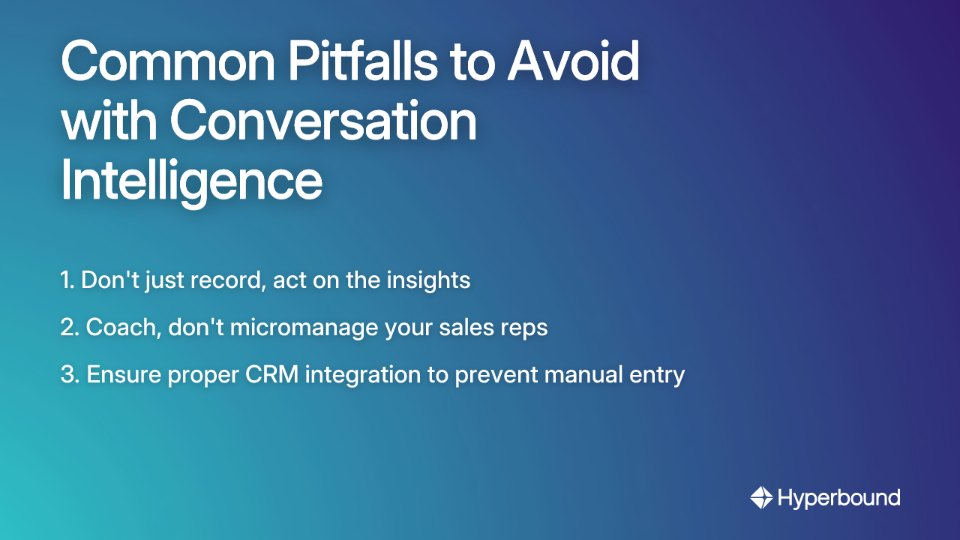
- Don't just record, act: Avoid treating conversation intelligence tools "merely as recording devices without acting on insights."
- Coach, don't micromanage: Use data to empower reps, not to "micromanage reps based on conversation data, which may reduce trust and motivation."
- Integrate your stack: Ensure good "CRM integration that prevents wasted time on manual entry and lost insights."
Conclusion
Moving from traditional metrics to advanced conversation analysis shifts your focus from lagging indicators to leading behaviors. It's about understanding the how and why behind sales performance, not just the what.
Hyperbound closes the loop as an end-to-end platform that not only helps analyze winning behaviors with AI Real Call Scoring but also allows teams to practice and master those behaviors at scale through AI Sales Roleplays.
The result? Reduced ramp time, consistent playbook execution, and improved core sales metrics through the transformation of conversation insights into tangible skills.
Frequently Asked Questions
What is AI conversation intelligence?
AI conversation intelligence is technology that uses artificial intelligence to analyze sales calls, meetings, and other customer interactions to uncover actionable insights. Unlike traditional metrics that only track outcomes (like call volume), it analyzes the content of conversations—what was said, how it was said, and key behaviors like question quality or objection handling. This helps identify what top performers do differently so those winning behaviors can be replicated across the team.
How is conversation intelligence different from just recording calls?
Conversation intelligence goes far beyond simple recording by actively analyzing the content of the conversations to provide structured data and insights. A standard recording tool is just a library of audio files. A conversation intelligence platform transcribes the calls, identifies speakers, detects keywords, scores the call against a playbook, analyzes sentiment, and flags risks. It turns unstructured audio into a searchable, analyzable database for performance coaching and market intelligence.
How can AI help with sales coaching?
AI helps sales coaching by automatically identifying coachable moments and performance gaps in every sales call, allowing managers to focus their time on targeted, data-driven feedback. Instead of randomly sampling a few calls, AI can score 100% of them against your sales methodology. It can pinpoint exactly where a rep struggled—whether with handling a specific objection, asking discovery questions, or setting next steps. This data provides the foundation for highly effective coaching.
What is automated call scoring?
Automated call scoring is a process where AI evaluates a sales conversation against a predefined set of criteria or a sales playbook without human intervention. It checks for key behaviors, such as whether the rep followed the discovery script, mentioned key value propositions, handled objections according to the playbook, and established a clear call-to-action. This provides a consistent, unbiased, and scalable way to ensure quality and playbook adherence across the entire sales team.
Will my sales reps feel micromanaged with this technology?
When implemented correctly, conversation intelligence should feel like a supportive coaching tool, not a micromanagement tool. The key is to frame it as a tool for professional development. The data is used to provide objective, fair feedback and identify areas for improvement, helping reps close more deals and earn more commission. It empowers reps with self-coaching tools and insights from top performers, helping them master their craft rather than simply scrutinizing their every word.
What is the ROI of using AI conversation intelligence?
The primary ROI of AI conversation intelligence comes from increased sales effectiveness, leading to higher win rates, larger deal sizes, and shorter sales cycles. By identifying and scaling the behaviors of top performers, you lift the middle 60% of your team. Additional ROI comes from reduced ramp time for new hires, improved forecast accuracy, and lower customer churn. As Forrester notes, businesses using these tools are significantly more likely to achieve substantial revenue growth.
Can this be used for teams other than sales?
Yes, conversation intelligence is highly valuable for any customer-facing team, including Customer Success, Account Management, and Support. Customer Success Managers can use it to analyze renewal conversations, identify churn risks, and ensure customers are realizing value. Support teams can use it to monitor call quality, ensure compliance, and identify trending product issues. The principles of analyzing conversations to improve outcomes apply across the entire customer lifecycle.

Ready to turn your sales conversations into your biggest competitive advantage? Explore Hyperbound's AI Sales Coaching platform or try it for free.
Book a demo with Hyperbound


