

.png)
Summary
- Traditional sales training is failing remote teams due to scheduling challenges and low engagement, making live role-plays difficult to scale.
- This article explores nine advanced techniques—including asynchronous coaching, gamification, and hyper-personalized scenarios—to modernize remote sales training.
- A key takeaway is that leveraging AI for on-demand practice provides a scalable way to deliver consistent, objective feedback without being limited by manager availability.
- To implement these strategies, Hyperbound's AI Sales Roleplays offer a platform for reps to master critical conversations anytime, driving consistent performance.
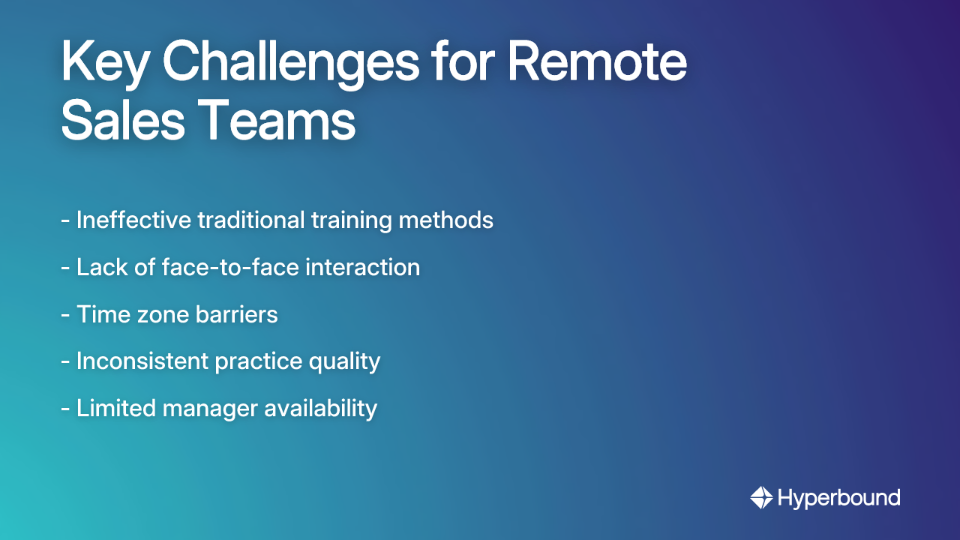
In the post-pandemic era, sales teams have become increasingly distributed, creating unique challenges for sales leaders. According to discussions on Reddit, traditional training methods like PowerPoint presentations are "ineffective and unengaging for remote learning," while the "lack of face-to-face interaction hinders collaboration in remote settings."
The reality is clear: static training materials and inconvenient live role-plays simply don't cut it anymore. Remote sales teams need dynamic, flexible training options that can overcome time zone barriers while providing consistent, high-quality practice opportunities.
Role playing for sales training has always been a cornerstone technique, but it needs reimagining for today's distributed workforce. This article explores nine advanced role-playing techniques specifically designed for remote sales teams, explaining both traditional approaches and how modern technology transforms these practices.
1. On-Demand Practice with AI-Powered Roleplays
Traditional Approach: Live role-play sessions between a rep and a manager or peer. While effective, this method is time-consuming, difficult to schedule across time zones, and performance varies widely depending on who plays the "buyer."
Advanced Technique: Hyperbound's AI Sales Roleplays enable reps to practice any sales scenario on-demand, 24/7, without depending on manager availability or accommodating complex schedules.
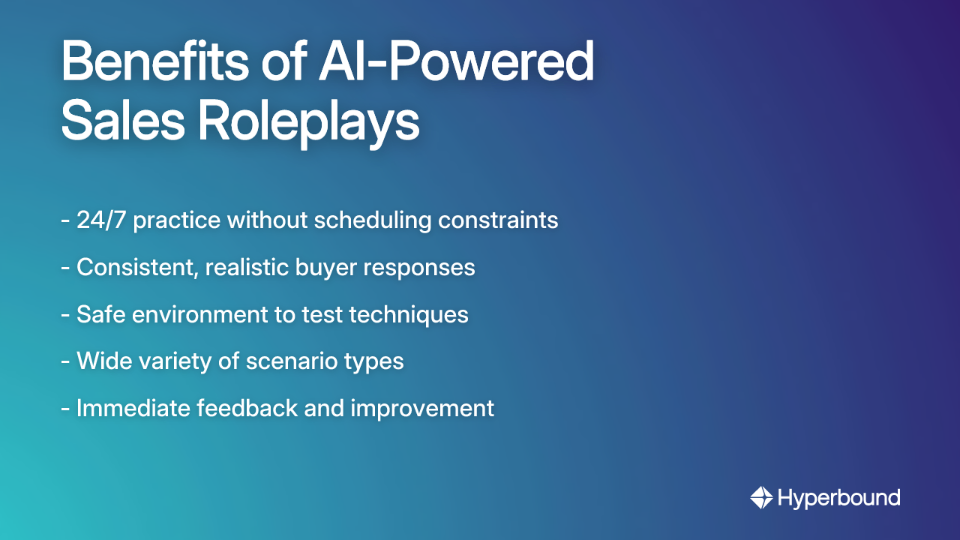
Sales reps engage with dynamic AI personas that respond realistically to their talk tracks, questions, and objections. This provides a safe, repeatable environment to practice critical conversations without risking live deals.
The platform offers diverse roleplay types including:
- Outbound: Cold calls, gatekeeper navigation, voicemail techniques
- Inbound: Warm calls, discovery conversations
- Demo: Product walkthroughs, technical demonstrations
- Post-Sales: Upsell/cross-sell conversations, renewal discussions
This approach allows for continuous practice regardless of time zones or manager availability, solving a critical pain point for global sales teams.
2. Asynchronous "Practice & Review" Loops
Traditional Approach: Immediate feedback during live role-play sessions. While valuable, this requires synchronous attendance and can create performance anxiety that hinders learning.
Advanced Technique: Implement asynchronous coaching loops where reps record role-play attempts at their convenience, and managers review with timestamped feedback later.
This method is particularly effective for global teams, as it allows sales reps to learn without needing to be online at the same time as their managers or other team members.
Hyperbound enhances this technique by automating the entire process. Reps complete AI Roleplays whenever convenient, and the platform instantly generates a shareable recording with an AI-powered scorecard. Managers can review the interaction and AI feedback when they have time, adding specific coaching notes while avoiding repetitive call reviews.
3. Gamified Role-Play Competitions
Traditional Approach: Role-playing as a mandatory training exercise that feels like a chore or evaluation rather than an opportunity to improve.
Advanced Technique: Tap into the competitive nature of salespeople by transforming role-playing into contests. This directly addresses the motivation challenge identified in user research where "sales teams require motivation through competition to enhance learning."
Create challenges around specific skills (e.g., "Best Objection Handling of the Week") with leaderboards to track progress and recognize top performers. This gamification drives engagement and participation in what might otherwise feel like a mundane training activity.
Hyperbound's platform includes built-in gamification features and leaderboards to motivate reps. The AI-powered scorecards provide objective metrics like talk ratios, questions asked, and methodology adherence—making competitions fair, data-driven, and engaging for the entire team.
4. Hyper-Personalized Scenario Simulation
Traditional Approach: Generic role-play scenarios like "sell me this pen." These lack the nuance of real-world sales conversations and fail to prepare reps for specific market challenges.
Advanced Technique: Create role-play scenarios tailored to your team's actual selling environment:
- Customize by ICP: Simulate conversations with different Ideal Customer Profiles, each with unique pain points, goals, and communication styles.
- Customize by Competitor: Practice handling specific competitive objections and positioning against named rivals.
- Customize by Product/Messaging: Drill new product messaging or pricing models to ensure consistent delivery.
Effective role-plays should be designed to address the specific, real-world scenarios your sales team faces regularly.
Hyperbound enables you to build a library of relevant scenarios that reps can access anytime, ensuring training is always practical and applicable to the deals they're working on. This addresses the common complaint that traditional training isn't tailored to real-world selling situations.
5. Data-Driven Feedback with AI Scorecards
Traditional Approach: Manager feedback that's subjective, potentially biased, and impossible to scale when reviewing every practice session for every rep.
Advanced Technique: Use AI to analyze and score role-play sessions against a predefined, objective methodology. This provides every rep with consistent, unbiased feedback on every practice attempt.
Hyperbound's AI Real Call Scoring automatically analyzes conversations and scores reps on key criteria defined in your sales playbook. The platform tracks "key behaviors and talk tracks" while the AI Deal Summary feature extracts important moments, objections, and buying signals—saving managers hours of review time.
This addresses the critical need for conversation intelligence tools identified in user research, where the "lack of conversation intelligence tools hinders continuous improvement in techniques."
6. Peer-to-Peer "Call Library" Review
Traditional Approach: Learning is siloed. Reps only learn from their own mistakes or their manager's direct feedback, missing valuable insights from peers.
Advanced Technique: Foster collaborative learning by creating a centralized library of best-practice role-plays and real calls. A shared repository of top-performing calls and successful strategies helps all team members learn from each other's experiences.
Encourage reps to review high-scoring calls from their peers to learn what excellence looks like in practice. This knowledge sharing breaks down the information silos that often form in remote teams.
Hyperbound's AI Coaching platform can automatically surface top-performing calls and successful techniques for peer learning. Managers can easily bookmark and share exemplary role-play recordings, creating a "greatest hits" library that reinforces best practices and accelerates the learning curve for the entire team.
7. Multi-Stakeholder & Team-Selling Drills
Traditional Approach: Role-plays are typically one-on-one (rep vs. "buyer"). This doesn't reflect the reality of complex B2B sales cycles with multiple decision-makers.
Advanced Technique: Simulate multi-party sales conversations where reps must navigate different stakeholders with competing priorities and perspectives.
This trains reps on advanced skills like building consensus, managing internal politics, and persuading buying committees—critical capabilities for enterprise sales that are rarely practiced in traditional role-play settings.
Hyperbound's platform supports Multi-Party Roleplays, allowing you to train reps on handling multi-stakeholder environments where alignment is key. This prepares them for the complex dynamics of enterprise deals where different personas (technical buyers, economic buyers, end-users) have distinct concerns and evaluation criteria.
8. Post-Sales Conversation Mastery (for CSMs & AMs)
Traditional Approach: Role-playing heavily focuses on top-of-funnel sales activities like prospecting and discovery. Post-sales skills are often neglected despite their critical importance to retention and growth.
Advanced Technique: Expand role-playing to cover the entire customer lifecycle. Create specific scenarios for Customer Success Managers and Account Managers to practice:
- Handling renewal price objections
- De-escalating angry customers
- Strategically identifying upsell opportunities
- Conducting effective quarterly business reviews
Hyperbound offers AI Post-Sales Roleplays designed specifically for CSMs and AMs. The platform includes scenarios for upselling, renewal conversations, and handling difficult customer situations—preparing post-sales teams to protect and grow revenue through effective communication.
9. AI Roleplays for Hiring & Candidate Assessment
Traditional Approach: Hiring managers rely on interviews and resumes to gauge a sales candidate's skills, which often doesn't predict on-the-job performance.
Advanced Technique: Use standardized role-play simulations as part of the hiring process to objectively assess a candidate's core selling abilities.
This provides a data-driven way to evaluate how candidates actually perform in lifelike selling situations, rather than just how well they interview. It also gives candidates a realistic preview of the role and expectations.
Hyperbound's AI Roleplay Hiring Assessments allow you to screen and evaluate sales talent at scale. Candidates complete standardized AI role-play scenarios, and the AI-powered scoring gives you objective measures of their pitching, discovery, and objection-handling skills—helping you "reduce mis-hires and improve the quality of sales talent."
The Future of Remote Sales Training
The shift to distributed sales teams requires an evolution in training approaches. Static presentations and inconvenient live role-plays are no longer sufficient. Advanced techniques like on-demand AI practice, asynchronous coaching, gamification, and hyper-personalized scenarios are essential for building high-performing remote teams.
By adopting these methods, you can:
- Reduce new hire ramp time by providing more practice opportunities
- Drive consistent messaging across globally distributed teams
- Improve key sales metrics through targeted skill development
- Scale effective coaching without burning out your managers
- Create a culture of continuous improvement regardless of location
The most successful sales organizations of tomorrow will be those that embrace these advanced role-play techniques today, giving their remote teams the tools they need to master critical skills—regardless of where they work.
Frequently Asked Questions
What is AI-powered sales role-playing?
AI-powered sales role-playing is an advanced training method where sales representatives practice conversations with a dynamic AI persona instead of a manager or peer. This technology provides a safe, on-demand environment for reps to rehearse various sales scenarios, such as cold calls, objection handling, and product demos, receiving instant, data-driven feedback on their performance.
Why is traditional sales role-playing ineffective for remote teams?
Traditional sales role-playing is often ineffective for remote teams due to several key challenges. Scheduling live sessions across different time zones is difficult, manager availability is limited, and the quality of practice can be inconsistent. Furthermore, remote settings lack the face-to-face interaction that facilitates collaborative learning, and reps may feel performance anxiety during live evaluations.
How does AI-powered role-playing solve the challenges of training remote sales teams?
AI-powered role-playing directly solves the challenges of remote training by providing a 24/7, on-demand practice platform that eliminates scheduling conflicts and time zone barriers. It offers consistent, realistic buyer interactions for every rep, allows for asynchronous coaching loops, and provides a safe space to fail and improve without the pressure of a live audience. This makes training more accessible, scalable, and effective for distributed teams.
What are the main benefits of using AI for sales practice?
The main benefits of using AI for sales practice include scalability, consistency, and data-driven insights. Every rep can practice anytime, anywhere, receiving standardized, objective feedback through AI scorecards. This saves managers significant time on call reviews, reduces new hire ramp time, ensures consistent message delivery, and fosters a culture of continuous improvement across the entire team.
Can AI role-play scenarios be customized for specific industries or products?
Yes, a key advantage of advanced AI role-play platforms is the ability to create hyper-personalized scenarios. You can tailor simulations to your specific Ideal Customer Profiles (ICPs), competitive landscape, product messaging, and pricing models. This ensures that the training is directly relevant to the real-world conversations your sales team has every day.
How does AI-driven feedback improve upon traditional manager coaching?
AI-driven feedback improves on traditional coaching by providing objective, consistent, and immediate analysis of every practice session. While manager feedback is invaluable, it can be subjective and is difficult to scale. AI scorecards analyze calls against a predefined methodology, tracking key metrics and behaviors without bias. This frees up managers to focus on high-level strategic coaching rather than repetitive call reviews.
How can sales leaders use AI role-playing to assess candidates during hiring?
Sales leaders can use AI role-playing to create standardized hiring assessments that objectively evaluate a candidate's core selling skills. Instead of relying solely on interviews, candidates can complete a simulated sales call, allowing hiring managers to see how they handle objections, ask discovery questions, and pitch the product. This provides a data-driven measure of their on-the-job potential and helps reduce mis-hires.
Ready to stop practicing on your customers? See how Hyperbound's AI Sales Coaching platform can transform your remote sales training. Schedule a Demo Today.

Book a demo with Hyperbound


