.png)


.png)
Summary
- Many accountability initiatives fail due to a "trust deficit," as they are often used for top-down blame rather than as a shared value for team empowerment.
- A successful accountability culture is built on four key pillars: radical clarity of expectations, open communication, genuine team ownership, and embracing mistakes as learning opportunities.
- The goal is to create a proactive culture of improvement, similar to how sales teams use platforms like Hyperbound's AI Sales Roleplays to practice skills and learn in a safe, repeatable environment.
When you hear the phrase "I'm going to hold you accountable," do you feel inspired—or do you immediately translate it to "manager-speak for I'm going to be a horrible person"? If you're like most developers, accountability initiatives often trigger skepticism rather than enthusiasm.
The problem isn't accountability itself. It's that in many software development environments, accountability has become a one-sided weapon wielded by management rather than a shared value that empowers teams. As one developer put it: "I'm supposed to hold myself accountable? For what? Other people's terrible planning and communication skills?"
This disconnect has created what workplace experts call a "crisis in accountability," where many employees don't understand what their organization aims to achieve or how their work contributes to those goals. But it doesn't have to be this way.
The Trust Deficit: Why "Accountability" Is a Loaded Term
Many developers have developed a healthy cynicism about accountability initiatives for good reason. Too often, these efforts feel like they're made in bad faith—designed to shift blame onto individual contributors while protecting management from scrutiny.
This cynicism manifests in questions like: "What is the point of doing it right when you are rewarded for doing it fast?" When teams are pushed to prioritize speed over quality, then held accountable for the resulting technical debt, trust erodes quickly.
As one developer bluntly stated, "Poor management is actually responsible for the vast majority of the mess the industry is in." When accountability is implemented as a top-down monitoring system rather than a mutual commitment, it becomes another form of micromanagement—which Ken Norton aptly called "the enemy of trust."
Before implementing any accountability software or system, this fundamental trust deficit must be addressed by redefining what accountability means in your organization.
Redefining Accountability: From Blame Game to Team Sport
True accountability isn't about pointing fingers after failures; it's about creating a proactive culture focused on learning and improvement. As Patrick Lencioni notes, accountability is actually a hallmark of high-performing teams, not dysfunctional ones.
When implemented effectively, a culture of healthy accountability:
- Improves productivity by clarifying expectations
- Boosts collaboration and trust between team members
- Encourages critical thinking when approaching challenges
- Facilitates initiative and ownership
- Minimizes conflicts by reducing misunderstandings
.png)
The key difference is shifting from accountability as a punishment tool to accountability as a shared value that helps everyone succeed. This means accountability must flow in all directions—upward, downward, and laterally—to be legitimate.
The Four Pillars of a Healthy Accountability Culture (Before the Software)
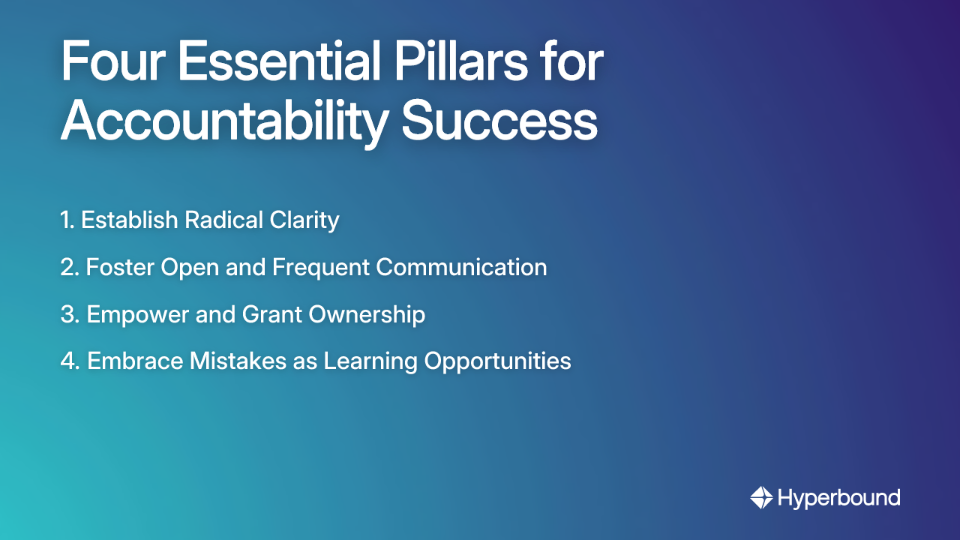
Before even considering accountability software, you must build the right foundation. Otherwise, you're simply digitizing and amplifying your existing dysfunction. Here are the four essential pillars:
Pillar 1: Establish Radical Clarity
The root of many accountability failures is ambiguity. According to Harvard Business Review, a staggering 82% of managers acknowledge they have limited to no ability to hold others accountable—often because expectations weren't clearly defined in the first place.
This manifests in development teams when, as one developer complained, "They never talked to us about what that work actually entails or means for us." Without clarity, accountability becomes arbitrary and unfair.
Actionable Step: Implement a RACI matrix (Responsible, Accountable, Consulted, Informed) for projects. This simple tool clarifies who owns which decisions and tasks, preventing the common scenario where everyone assumes someone else is handling a critical dependency.
Pillar 2: Foster Open and Frequent Communication
Poor communication is the silent killer of accountability. When teams operate with insufficient information or are afraid to speak up about problems, issues fester until they become crises—at which point "accountability" becomes a blame game.
Actionable Step: Adopt agile methodologies with regular touchpoints like daily stand-ups and retrospectives. These create safe settings for teams to express challenges before they become blockers. The key is ensuring these aren't just status updates for management but genuine opportunities for collaborative problem-solving.
Pillar 3: Empower and Grant Ownership
Micromanagement and accountability are fundamentally incompatible. True accountability requires giving teams both the responsibility for outcomes AND the authority to make decisions about how to achieve them.
Actionable Step: Empower team members to question and adapt requirements while keeping client interests in mind. As developers at Dark Reading noted, "Accountability stems from knowledge, commitment, and the authority to make decisions." This means managers must be willing to let go and trust their teams.
Pillar 4: Embrace Mistakes as Learning Opportunities
In many organizations, admitting mistakes can feel career-limiting. This creates a culture of hiding problems until they're too big to conceal—exactly the opposite of true accountability.
Actionable Step: Implement blameless post-mortems after project challenges. Focus questions on "what" rather than "who," and use frameworks like Jonathan Raymond's "accountability dial" to determine appropriate responses to performance issues, starting with supportive conversations before considering more serious interventions.
This shift towards a learning-oriented culture is also transforming other high-performance fields. In sales, for example, teams are moving beyond simple performance tracking. Instead, they use AI coaching platforms like Hyperbound to create a culture of proactive practice and improvement. By simulating realistic selling scenarios, these tools allow reps to make mistakes, receive instant feedback, and master their skills in a safe environment—a powerful model of accountability focused on development, not just delivery.
Implementing Accountability Software the Right Way
Once you've established the cultural foundations, accountability software can amplify your efforts—rather than substitute for them. Here's how to implement these tools without falling into the micromanagement trap:
Step 1: Choose the Right Kind of Software
The marketplace offers various types of accountability tools, and choosing the wrong one can undermine your efforts. Be aware of these broad categories:
Personal/Moral Accountability Tools: Solutions like Covenant Eyes, Accountable2You, or Ever Accountable are designed for personal monitoring and often involve detailed activity tracking with reports sent to accountability partners. While effective for personal use, these monitoring-heavy approaches can create distrust in professional settings.
Professional Team Accountability Tools: These focus on transparency, task management, and collective progress rather than surveillance. Look for features that support:
- Task management with clear ownership
- Goal-setting and tracking
- Performance analytics focused on patterns, not individual blame
- Real-time communication hubs
- Data visualization that helps everyone understand progress
The key difference is whether the tool emphasizes transparency for the entire team versus monitoring individual behavior for management.
.png)
Step 2: Formalize the "Why" and "How"
Before implementation, document the purpose of the software in a playbook with ground rules. This should directly address the "bad faith" concerns many developers have about accountability initiatives.
Your playbook should clarify:
- The specific problems the software aims to solve
- How the data will (and won't) be used
- Who has access to different types of information
- How success will be measured
Make this a collaborative document, inviting input from the team. This transparency helps ensure the software is seen as a tool for collective improvement rather than managerial surveillance.
Step 3: A Phased Rollout Plan
Implementing accountability software requires thoughtful change management. Follow these steps:
- Customize for Your Organization: Tailor software settings to align with your team's existing workflows and terminology.
- Introduce to Employees: Clearly explain the software's purpose and benefits; provide comprehensive training with emphasis on how the tool helps them, not just management.
- Encourage Real-Time Tracking: Create a culture that normalizes regular updates on task progress. This works best when leadership models the behavior first.
- Review and Adjust: Regularly assess the software's impact and make adjustments based on team feedback. If certain features create tension or distrust, be willing to modify or disable them.
- Use Performance Analytics Wisely: Analyze tracking data to evaluate both team and process performance, focusing on trends and system improvements rather than individual blame.
Accountability as a Service, Not a Sentence
The difference between accountability that empowers and accountability that demoralizes lies in one crucial distinction: Is it something done to the team or for the team?
When implemented thoughtfully, accountability software becomes a service that helps everyone succeed by providing clarity, facilitating communication, and making dependencies visible. It removes the anxiety of "I hope everyone else is doing their part" and replaces it with confidence based on transparency.
Remember that software is merely a tool—it can't create accountability in an environment where trust is broken, expectations are unclear, or communication is poor. Build your culture first, then find technology that amplifies your values rather than attempting to substitute for them.
By reframing accountability as a shared commitment to excellence rather than a mechanism for control, you transform what was once a dreaded concept into a competitive advantage that benefits everyone—developers, managers, and customers alike.
Book a demo with Hyperbound


