.png)


.png)
Summary
- A structured onboarding process can cut ramp time from an average of 7 months to just 3-4 months and increase new hire retention by 60%.
- Replace overwhelming information dumps with a structured 30-60-90 day plan focused on key milestones and practical application.
- Key strategies include pre-boarding before day one, using microlearning for just-in-time training, and fostering a culture of continuous coaching.
- Provide reps with risk-free practice and instant feedback on real-world scenarios using AI Sales Roleplays to accelerate skill development.
You've just hired a promising new sales rep. They arrive on day one buzzing with enthusiasm, eager to make an impact. Then you hand them a 40-page onboarding document and schedule them for hours of training videos. Almost instantly, you can see that initial excitement drain from their face.
Sound familiar? Traditional sales onboarding often takes too long, feels overwhelming, and disconnects from real-world selling. According to research, it takes an average of 7 months to fully onboard a new sales rep—an eternity in today's fast-paced business environment where every day of non-productivity costs your company money.
But here's the good news: with the right structure and approach, you can cut that time down to 3-4 months without sacrificing quality. The goal isn't to rush through critical training but to make the process more efficient, relevant, and impactful.
Why You Need to Rethink "Accelerated" Onboarding
Before diving into strategies, let's understand the stakes. Effective onboarding isn't just about getting reps selling faster—it's about setting them up for long-term success:
- Higher retention: Employees are 60% more likely to stay with an organization for three years or longer when a standardized onboarding process is in place.
- Better performance: Companies with effective onboarding report a 14% boost in win rates and 73% higher quota attainment rates.
- Faster productivity: Well-structured onboarding can make new hires productive 3.4 months sooner.
So how do you accelerate onboarding without cutting corners? Here are five proven strategies:
.png)
1. Start Before Day One with Strategic Pre-Boarding
Reduce First-Day Anxiety and Administrative Overload
The onboarding process should begin before your new hire's official start date. This approach reduces anxiety and handles administrative work upfront, making Day One about meaningful learning instead of paperwork.
As one sales manager on Reddit noted: "One of the biggest things we see is how rushed it can feel to new starters." Pre-boarding alleviates this by giving new hires time to mentally prepare and absorb foundational information at their own pace.
What to Include in Your Pre-Boarding Kit
- Tool Access: Provide early access to essential tools like your CRM, communication platforms (Slack/Teams), and sales enablement software.
- Welcome Packet: Include a team welcome video, an overview of company values, and an introduction to their mentor or "buddy."
- Light Learning Materials: Share high-level information on the company's mission, market, and ICP (Ideal Customer Profile). This addresses a common pain point where onboarding is too "product-focused" while context about customers and their problems is left for reps to figure out in the field.
2. Implement a Structured 30-60-90-Day Plan
Map Out Core Competencies and Milestones
A documented, standardized plan provides clarity and focus, ensuring consistency across all new hires. Without this structure, reps often feel lost or overwhelmed.
Outline the essential skills new hires need to develop within specific timeframes, such as product knowledge, negotiation techniques, and closing strategies. Document everything from sales processes to call scripts and make it easily accessible.
This level of organization pays off: a clear plan can increase sales efficacy and generate up to an additional $60,000 in revenue per rep early in their tenure.
A Sample 90-Day Onboarding Schedule
- Days 1-30: Focus on foundational knowledge. Company values, product overview, sales methodology, introductions to cross-functional teams, and market/ICP training.
- Days 31-60: Move to practical application. CRM training, AI-powered role-playing exercises to practice discovery calls and objection handling, deep dives into the sales process, and shadowing top performers.
- Days 61-90: Build independence. Live-call shadowing, hands-on coaching, objection handling, and beginning to manage their own leads.
- Beyond 90 Days: Transition to ongoing development with performance reviews and mentorship.
Using a detailed sales onboarding checklist ensures no critical element is overlooked and helps track progress systematically.
3. Personalize the Experience with Blended, Just-in-Time Learning
Ditch Information Dumps for Microlearning
Many sales reps report feeling "overwhelmed by the volume of content" they need to absorb. Traditional training approaches can lead to reps forgetting 80-90% of what they learned within a month.
Instead, break down learning into spaced, bite-sized practice sessions:
- Replace marathon training sessions with short, focused learning modules
- Diversify training methods: use 1-on-1 coaching, peer training, shadowing, role-playing, and hands-on projects
- As one successful sales leader shared on Reddit: "Instead of massive documents, we give them playlists of real calls categorized by discovery calls, demo calls, etc."
Leverage Technology for Personalized Learning Paths
Use AI Sales Coaching platforms like Hyperbound to customize the onboarding experience based on a rep's role, background, and progress. This allows you to:
- Create personalized learning paths that adapt to individual strengths and weaknesses
- Facilitate "just-in-time" learning, where training materials are integrated directly into daily workflows (e.g., a battle card popping up in the CRM when a competitor is mentioned)
- Track progress and identify areas where additional support may be needed

4. Foster a Culture of Continuous Coaching and Peer Support
The Power of Mentorship and the Buddy System
"New hires are often left to figure things out alone and micromanaged later on, which is counterintuitive," notes one experienced sales leader on Reddit. This sink-or-swim approach is demoralizing and inefficient.
Instead:
- Assign mentors or implement a buddy system to provide continuous support and a safe space for questions
- Pair new reps with high-performing colleagues to accelerate learning through observation and modeling
- Create a team culture where, as one sales professional put it, "mutual support and collegial behavior" is the norm
Research shows that organizations with strong coaching cultures experience significantly higher employee engagement and retention.
Use AI for Real-Time Feedback and Coaching
Address the need for immediate, actionable feedback. As one innovative sales manager shared: "They constantly improve with AI coaching that provides new reps with feedback from their very first call."
- Leverage a platform like Hyperbound for AI-powered roleplays that simulate common objections and provide reps with real-time coaching insights
- Use AI Real Call Scoring to analyze both practice and real-world calls, giving new reps objective feedback and concrete examples of what good (and bad) looks like
- Schedule regular 1:1 check-ins with managers to review progress, tackle challenges, and provide constructive feedback
5. Measure Everything: Align Onboarding with Business Outcomes
Key Performance Metrics to Track
To prove that an accelerated process is effective (not just rushed), tie onboarding activities to tangible business results:
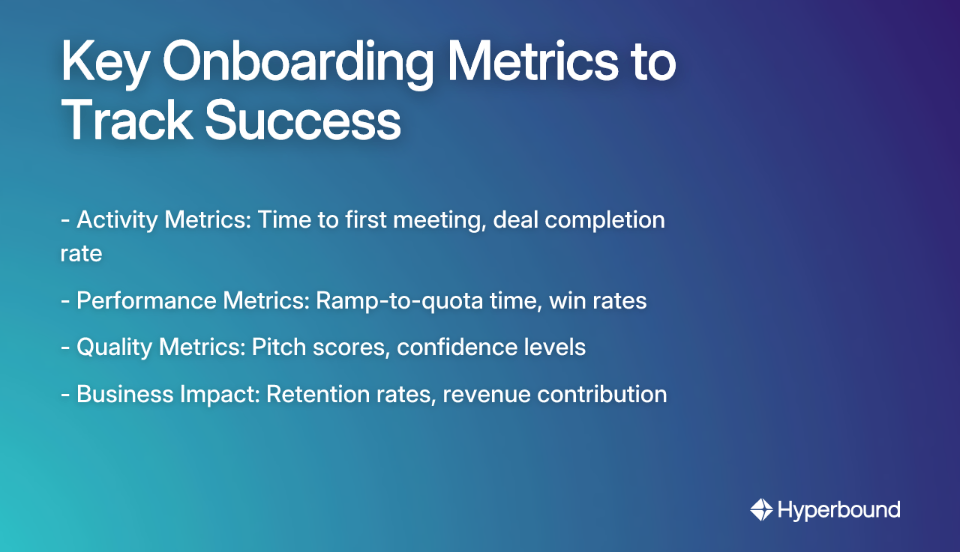
Activity-Based Metrics:
- Time to first meeting booked
- Time to first deal
- Certification completion rate
Performance-Based Metrics:
- Ramp-to-sales-quota timeline
- Quota attainment
- Win rates
- Sales cycle length
Qualitative Metrics:
- Pitch score improvement over time (tracked automatically with tools like Hyperbound's AI Real Call Scoring)
- New hire retention rate
- Confidence level (self-reported)
Create a Feedback Loop for Continuous Improvement
Regularly gather feedback from new hires through surveys and 1:1 check-ins to identify bottlenecks and areas for improvement. Use the performance data to refine training content, adjust the 30-60-90 plan, and optimize the overall process.
This iterative approach ensures your onboarding program evolves with your business and continuously improves over time.
Conclusion: Build Momentum, Not Burnout
Accelerating sales onboarding isn't about skipping crucial steps or overwhelming new reps with information dumps. It's about being more intentional, efficient, and human-centric in how you structure the learning journey.
By implementing pre-boarding, structured 30-60-90 day plans, personalized microlearning, continuous coaching, and data-driven measurement, you transform onboarding from a necessary chore into a strategic advantage.
The result? Confident, high-performing reps who ramp up quickly, hit quota consistently, and stick around longer—giving your organization the competitive edge it needs in today's challenging marketplace.
Frequently Asked Questions
How long should it take to onboard a new sales rep?
Ideally, a new sales rep should be fully onboarded and productive within 3-4 months. While the industry average is closer to 7 months, a well-structured, accelerated program that includes pre-boarding, a 30-60-90 day plan, and continuous coaching can significantly shorten this ramp time without sacrificing quality.
What is the most important part of sales onboarding?
The most critical part of sales onboarding is providing a clear, structured plan combined with continuous coaching. A documented 30-60-90 day plan prevents new hires from feeling overwhelmed, while consistent feedback and mentorship build confidence and accelerate skill development long after the initial training period ends.
Why is a 30-60-90 day plan so important for sales onboarding?
A 30-60-90 day plan is crucial because it provides a clear, structured roadmap for new hires. It breaks down the immense amount of information into manageable phases, sets clear expectations for what a rep should know and be able to do at each stage, and ensures a consistent and comprehensive learning experience for everyone.
What are the most common mistakes to avoid in sales onboarding?
The most common mistakes include information overload, lack of structure, and insufficient real-world practice. Many companies dump too much information on new reps at once, fail to provide a clear plan, and don't offer enough opportunities for safe practice, which leads to reps who are knowledgeable but not skilled.
How can AI help accelerate the onboarding process?
AI accelerates onboarding by providing personalized, scalable, and just-in-time training. AI-powered tools like Hyperbound offer realistic role-playing scenarios for reps to practice objections and discovery calls safely. They can also score real calls to provide immediate, objective feedback, helping new hires improve much faster than with manager coaching alone.
What key metrics should I track to measure onboarding success?
To measure onboarding success, you should track a mix of activity, performance, and business impact metrics. Key indicators include time-to-first-deal, ramp-to-quota time, quota attainment rates, win rates, and new hire retention. Tracking these KPIs demonstrates the direct link between effective onboarding and business results.

Book a demo with Hyperbound


