.png)


.png)
You've been there before. That awkward moment when you're speaking with a prospect, the conversation is flowing, you've made your pitch, and then... silence. You know it's time to ask for the sale, but something holds you back. That nagging fear of sounding pushy or desperate freezes you in place, and the moment slips away.
If this resonates with you, you're far from alone. So many salespeople are scared to directly ask for business, even though that's precisely what they're there to do. They hesitate, creating awkwardness that can transfer to the prospect and potentially lose the sale from their lack of certainty.
But what if there was a way to completely flip the script? A method that positions you not as the all-knowing expert pushing for a sale, but as a humble learner genuinely seeking understanding?
Enter "The Absent-Minded Beggar" – a powerfully counter-intuitive sales approach that leverages strategic vulnerability to build unprecedented levels of trust and rapport.
Why Vulnerability is Your New Superpower in Sales
In today's hyper-informed world, prospects are more educated and skeptical than ever. According to recent studies, a staggering 58% of consumers don't trust businesses. The traditional "I'm the expert, let me tell you what you need" approach often puts prospects on the defensive, creating an adversarial dynamic that rarely leads to success.
The Absent-Minded Beggar technique flips this dynamic entirely. By strategically positioning yourself as confused or seeking help, several powerful psychological shifts occur:
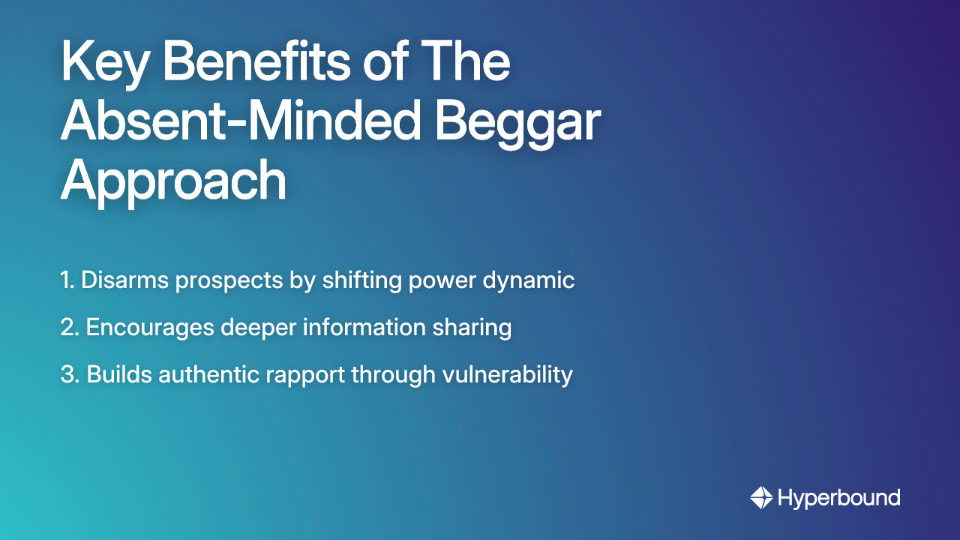
1. You instantly disarm prospects
When you ask for help rather than trying to demonstrate expertise, you shift the power dynamic. The prospect becomes the teacher, the expert, the guide – roles that humans naturally enjoy. This immediately lowers their defenses and creates a collaborative rather than combative atmosphere.
"Prospects are like women, they sense if you are desperate and run a mile," noted one sales professional in a Reddit discussion. The beauty of the Absent-Minded Beggar approach is that it replaces desperation with genuine curiosity.
2. You encourage deeper information sharing
When you position yourself as learning from the customer instead of being an omnipotent expert, they open up more freely. Research on vulnerability in sales highlights that prospects are far more likely to share their true challenges, concerns, and decision-making criteria when they don't feel they're being "sold to."
Remember: "If you ask the right questions, the prospect will tell you how to sell them." This insight from an experienced salesperson encapsulates the essence of the technique – by appearing confused or uncertain, you create space for the prospect to reveal exactly what matters to them.
3. You build authentic rapport through vulnerability
As counterintuitive as it seems, showing strategic vulnerability builds trust faster than projecting unwavering confidence. Consultative selling experts emphasize that modern buyers value authenticity over polished pitches. When you admit you don't have all the answers and genuinely seek to understand their situation, you create a human connection that transcends the typical transactional relationship.
Mastering the Art of the Absent-Minded Beggar
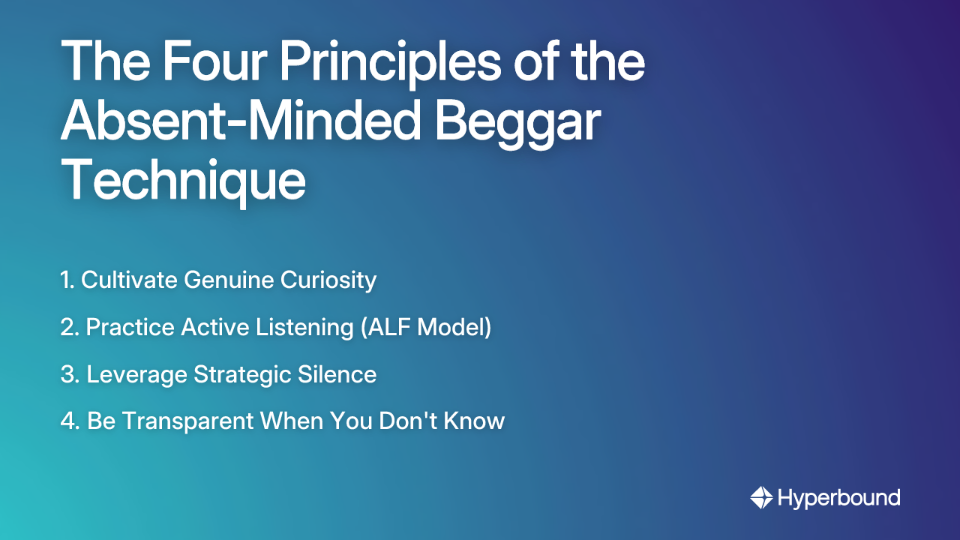
The Absent-Minded Beggar isn't about pretending to be incompetent or clueless. It's about strategically leveraging genuine curiosity to create a collaborative sales environment. Here's how to master this powerful approach:
Principle 1: Cultivate Genuine Curiosity
This technique fails the moment it feels manipulative or inauthentic. You must develop a true desire to understand your prospect's business, challenges, and goals.
"Treat people how you want to be treated and don't lie," advises a top-performing salesperson. Your confusion or need for clarification must come from a place of genuine interest, not manipulation.
When approaching high-ticket sales especially, this authentic curiosity becomes your most valuable tool. Rather than commission breathe (that desperate energy prospects can sense), you project sincere interest in their situation.
Principle 2: Practice Active Listening (The ALF Model)
One of the most common mistakes in sales is failing to truly listen. As one blunt sales professional puts it: "Listen to me you lil shit." The Absent-Minded Beggar approach requires masterful listening skills.
The ALF Model, recommended by The Entourage's sales training, provides a simple framework:
- Ask: Begin with open-ended questions that demonstrate your interest
- Listen: Pay full attention to their response without formulating your next question
- Formulate: Create your next question based directly on what they've shared
This cycle creates a virtuous loop of discovery that positions you as genuinely interested in their needs rather than just waiting for your turn to speak.
Principle 3: Leverage Strategic Silence (The Pregnant Pause)
"The good ol' pregnant pause" is perhaps the most powerful tool in the Absent-Minded Beggar's arsenal. After asking a question or presenting information, simply stop talking. The natural human discomfort with silence will often prompt your prospect to elaborate, sharing insights they might otherwise withhold.
This technique is particularly effective when handling objections. Rather than immediately jumping to counter every concern, a thoughtful pause followed by a curious question demonstrates respect for their perspective while encouraging them to expand on their thinking.
Principle 4: Be Transparent When You Don't Know
There's tremendous power in saying "I don't know" or "I'm not sure I understand." Rather than triggering FOMO (fear of missing out) through artificial scarcity, you create genuine interest through honesty.
When you encounter a question you can't answer, resist the urge to bluff. Instead, try: "That's an excellent question I don't have the answer to right now. Let me find out and get back to you." This transparency builds more trust than pretending to know everything.

Practical Scenarios & Scripts for Every Situation
Let's explore how to apply the Absent-Minded Beggar approach across different sales scenarios with specific scripts you can adapt:
Scenario 1: The Discovery Call (Uncovering Needs)
Goal: Move beyond surface-level pain points to understand deeper needs.
Script: "I've been reviewing your company's work in [industry], and honestly, I'm a bit confused about how you currently handle [specific process]. Could you help me understand what your day-to-day looks like there?"
This opener positions you as someone genuinely trying to learn rather than an expert with preconceived solutions. It invites the prospect to educate you, establishing them as the authority in the conversation.
Scenario 2: When a Prospect Goes Silent
Goal: Re-engage without being pushy.
Script: "I realize I might have missed something important here. I'm a bit confused about your hesitation – could you help me understand what concerns you have that I haven't addressed?"
This approach uses your confusion as a tool to draw out objections they might otherwise withhold. It's particularly effective for rescuing deals stuck in demo purgatory – that frustrating state where prospects keep taking demos but never move forward.
Scenario 3: Handling Objections with Curiosity
Goal: Understand the real reason behind an objection, not just the stated concern.
Prospect says: "The price is too high."
Script: "Thanks for sharing that. It helps me understand where you're coming from. I'm curious though – could you walk me through how you're thinking about the budget for something like this? I want to make sure I'm not missing something important."
Notice how this response doesn't immediately jump to defending your pricing or offering discounts. Instead, it uses the mirror technique by acknowledging their concern, then invites them to elaborate, often revealing the true objection hiding behind "price."
Scenario 4: The Vulnerable Close (Asking for the Sale)
Goal: Overcome the fear of asking for the sale by making it a collaborative decision.
Script: "Based on everything you've shared, it seems like our [product/service] could help with [specific problems they've mentioned]. But I'm not entirely certain if we're the right fit for your specific situation. From your perspective, do you see value in moving forward, or are there concerns I haven't addressed?"
This permission-based close transforms the typically awkward "asking for the sale" moment into a natural extension of your collaborative conversation. It demonstrates respect for their decision-making process while still moving toward a conclusion.
Pitfalls to Avoid: When Being a "Beggar" Goes Wrong
While the Absent-Minded Beggar approach is powerful, it can backfire if implemented incorrectly. Here are the most common pitfalls to avoid:
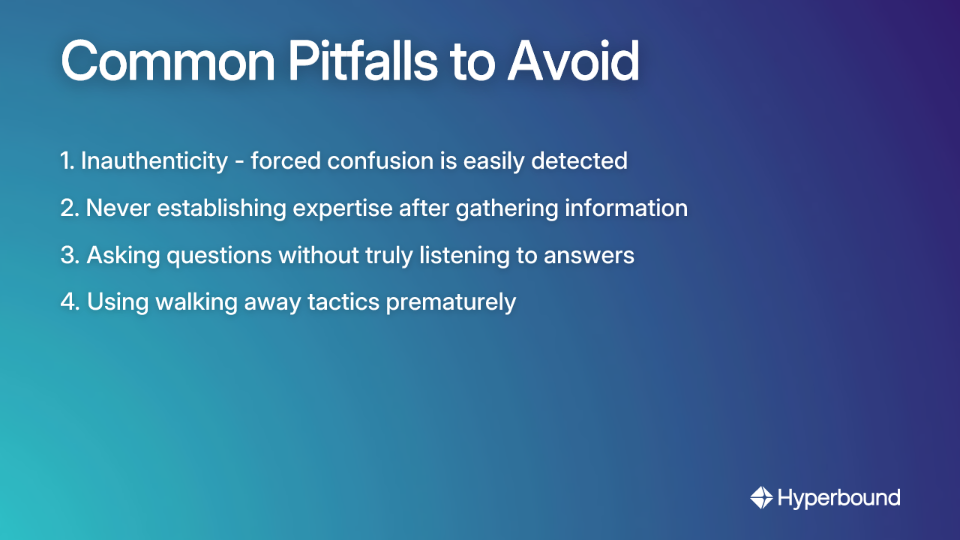
Mistake 1: Inauthenticity
If your confusion feels forced or manipulative, prospects will detect it immediately. Remember that "prospects sense if you are desperate and run a mile." Your curiosity and questions must come from a genuine place of wanting to understand.
Mistake 2: Never Establishing Expertise
The goal isn't to appear incompetent. The "absent-minded" part is strategic and temporary. After gathering information, you must pivot to providing a tailored, expert solution and deliver a compelling value statement that demonstrates your understanding of their needs.
Mistake 3: Asking and Not Listening
The worst implementation of this technique is asking thoughtful questions only to interrupt the answers with your pitch. This destroys trust faster than almost any other sales mistake. When you ask, commit to truly hearing the response.
Mistake 4: Using Walking Away Tactics Prematurely
Some salespeople confuse the Absent-Minded Beggar approach with simply threatening to walk away from the deal. These are fundamentally different strategies. Only implement walking away tactics when you've exhausted all other options for understanding and addressing the prospect's needs.
Transform Your Conversations, Transform Your Results
The Absent-Minded Beggar isn't about weakness – it's about strategic vulnerability that transforms sales from a pitch into a partnership. In today's selling environment, where buyers are more informed and skeptical than ever, this approach cuts through the noise by creating authentic human connection.
As one sales professional put it: "If you ask the right questions, the prospect will tell you how to sell them." The Absent-Minded Beggar technique provides the perfect framework for asking those questions in a way that encourages honest, revealing responses.
In your next sales interaction, try asking just one "help me understand" question instead of making a statement. Pay close attention to how the dynamic shifts, how the prospect engages, and how much more you learn about their true needs. This small change in approach might just transform your entire sales process – and your results.

Frequently Asked Questions
What is "The Absent-Minded Beggar" sales technique?
The "Absent-Minded Beggar" is a sales technique that involves using strategic vulnerability and genuine curiosity to build trust with prospects. Instead of positioning yourself as an all-knowing expert, you adopt the mindset of a learner, asking questions to better understand the prospect's situation, which disarms them and encourages open communication.
Why is vulnerability effective in modern sales?
Vulnerability is effective in modern sales because it builds authentic rapport and trust in a world where buyers are highly skeptical. By shifting the power dynamic and positioning the prospect as the expert, you lower their defenses, encourage deeper information sharing, and create a collaborative, human connection that transcends a typical transactional relationship.
How do I start using the "Absent-Minded Beggar" approach?
You can start using this approach by focusing on four key principles: cultivating genuine curiosity about your prospect's business, practicing active listening (Ask, Listen, Formulate), leveraging strategic silence to encourage elaboration, and being transparent when you don't know an answer. Begin by incorporating simple "help me understand" questions into your next sales call.
Is this technique just about pretending to be incompetent?
No, this technique is not about pretending to be incompetent; it's about strategic curiosity. The goal is to temporarily set aside the "expert" persona during the discovery phase to encourage the prospect to share information freely. After you have gathered the necessary insights, you must pivot back to an expert role to provide a tailored, compelling solution.
How does this method help with handling sales objections?
This method helps handle objections by using curiosity instead of confrontation. When a prospect raises an objection, instead of immediately countering it, you can ask questions like, "Could you walk me through how you're thinking about that?" This approach helps you uncover the true root of the concern, rather than just addressing the surface-level objection, leading to a more productive conversation.
Can the "Absent-Minded Beggar" technique be used in high-ticket sales?
Yes, this technique is particularly effective in high-ticket sales where trust, understanding complex needs, and building strong relationships are critical. By projecting sincere interest instead of "commission breath," you can uncover nuanced challenges and decision-making criteria, allowing you to tailor a high-value solution that genuinely fits the prospect's needs.
Book a demo with Hyperbound


